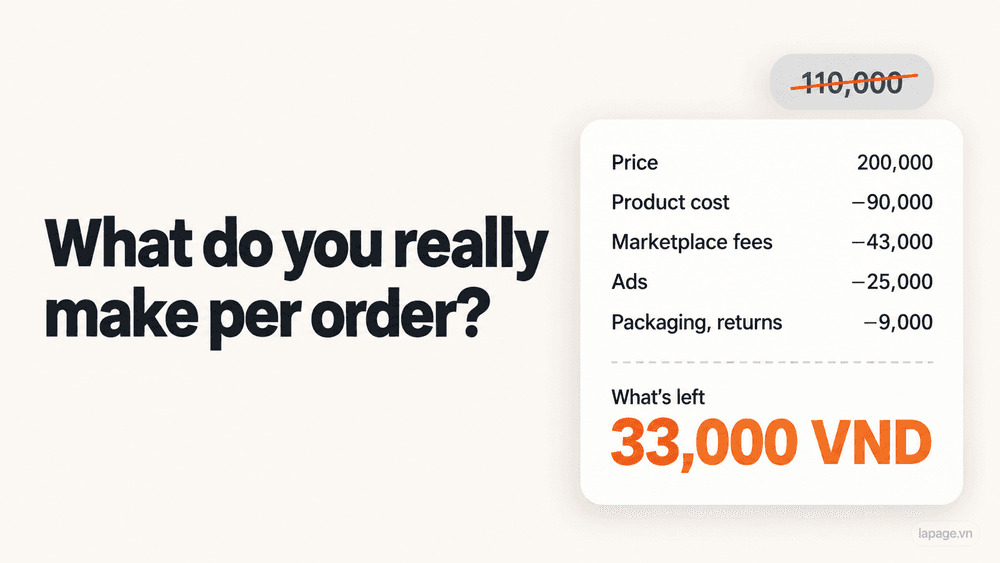
How much do you really make per order after marketplace fees and ads?
A 200,000 VND order bought in at 90,000 looks like 110,000 profit, but may leave only 33,000. Shopee and TikTok Shop fees as of October 2026, a line-by-line table, the break-even ROAS formula, a comparison with returning customers, and five steps to work it out for your own shop.

How much do you really make per order after marketplace fees and ads?
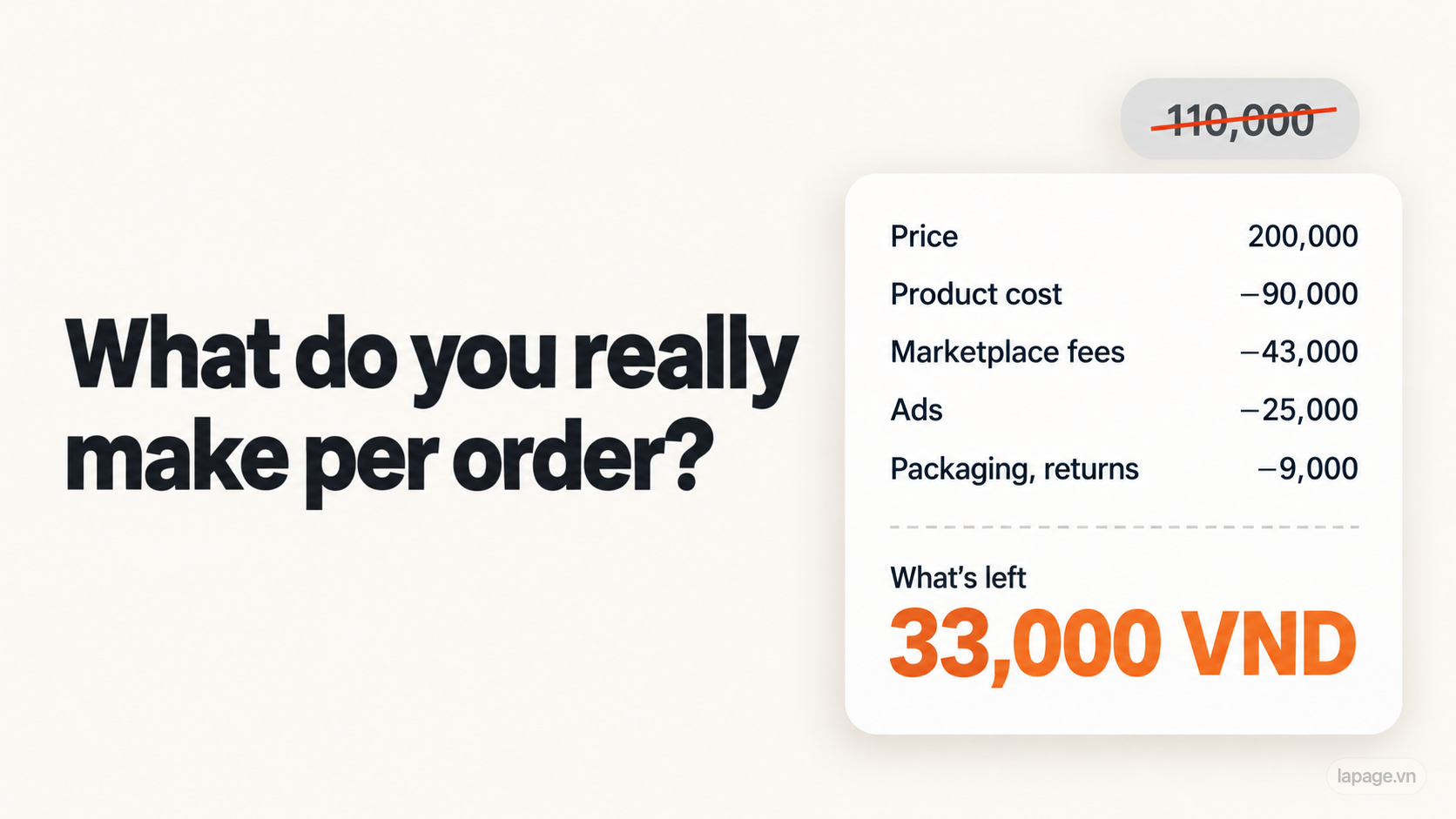
A 200,000 VND order, bought in at 90,000. You think you made 110,000. In reality, it may be closer to 33,000.
Business owners ask this question all the time, and rarely get a clear answer: how much do we actually make on each order? Marketplace revenue is visible every day. Profit per order is scattered across platform fees, ad spend, packaging and returns, and almost nobody adds it all up.
This article adds it up for you, line by line, on one example order. Then it shows the number many shops have never calculated: break-even ROAS.
The numbers below are illustrative examples, not data from a specific shop. Marketplace fees change often and differ by category, so check your own Seller Center before you set prices.
What the marketplaces charge (October 2026)
In 2026, both Shopee and TikTok Shop in Vietnam raised their fees several times. The main items:
Shopee (regular sellers, not Mall):
- Fixed fee: set by category, from about 1.5% to 18% of the item value (VAT included), effective 23 May 2026. Fashion and beauty are among the higher categories.
- Transaction processing fee: 6% of the order value, for every payment method.
- Infrastructure fee: 3,000 VND per order.
- If you join programs such as Voucher Xtra or free shipping: a few more percent.
TikTok Shop:
- Transaction fee: 6% of the order value, from 9 May 2026.
- Order processing fee: 3,000 VND per delivered order.
- Platform commission: by category, around 12–16% in many categories.
- Affiliate commission for creators (KOCs, KOLs): set by the shop, usually 10% or more if you want people making videos for you.
In short: marketplace fees already take about 20–25% of the order value, before you spend anything on ads.
Adding up one 200,000 VND order on Shopee
Say you sell a fashion item for 200,000 VND, your cost is 90,000 VND, the category's fixed fee is 14%, and your ads run at a ROAS of 8 (every 1 VND of ads brings in 8 VND of revenue).
| Item | How it's calculated | Amount (VND) |
|---|---|---|
| Selling price | 200,000 | |
| Product cost | 45% of price | −90,000 |
| Fixed fee | 14% | −28,000 |
| Transaction processing fee | 6% | −12,000 |
| Infrastructure fee | per order | −3,000 |
| Ads | ROAS 8 = 12.5% of revenue | −25,000 |
| Packaging | box, tape, thank-you card | −5,000 |
| Returns and cancellations | spread across all orders | −4,000 |
| What's left | 33,000 (16.5%) |
From 110,000 "on paper" down to 33,000. And that still excludes tax, staff, rent, software and electricity. What actually ends up in your pocket is lower still.
In this example, marketplace fees come to 43,000 VND, or 21.5% of the price. Ads add another 12.5%. Together, those two items are larger than the profit that's left.
The most important number: break-even ROAS
Many shops look at their ROAS and think "4 is fine." Whether it is fine depends on how much each order has left to spend on ads.
In the example above, before ads, each order leaves:
200,000 − 90,000 − 43,000 − 5,000 − 4,000 = 58,000 VND
That is the most you can spend on ads for one order without losing money. Which gives a simple formula:
Break-even ROAS = Selling price ÷ Profit before ads
200,000 ÷ 58,000 ≈ 3.4
In practice:
- ROAS 8: ads cost 25,000, profit is 33,000.
- ROAS 4: ads cost 50,000, profit is only 8,000.
- ROAS 3: ads cost about 66,700, a loss of about 8,700 per order.
All three are "ads that bring in orders." But at ROAS 3, the more you sell, the more you lose. That's how some shops grow revenue every month and still can't find the money at the end of it.
What about customers who come back?
Now take an existing customer who has bought from you before and places the exact same order through your own Zalo or website:
| Item | New order via marketplace + ads | Returning customer via your channel |
|---|---|---|
| Product cost | −90,000 | −90,000 |
| Marketplace fees | −43,000 | 0 |
| Ads | −25,000 | 0 |
| Packaging | −5,000 | −5,000 |
| Returns and cancellations | −4,000 | much lower with regulars |
| Shipping you cover | 0 | about −25,000 |
| What's left | 33,000 | about 80,000 |
Even if you pay for shipping yourself, the returning customer's order earns more than twice as much.
There's one condition: you have to be able to reach that customer. If they only exist inside the marketplace, then next time they want to buy, you pay the marketplace fees again, and quite likely pay for ads again so they find your shop among dozens of others.
Marketplaces are great for finding new customers. But if every order, including orders from your regulars, has to go through the marketplace and through ads, you are paying for the same customer over and over.
Work it out for your own shop in 15 minutes
Open a spreadsheet, take your single best-selling product, and do five things:
- Take the real selling price, after any vouchers your shop pays for.
- Open your Seller Center, look at one completed order, and copy every fee deducted from it. This is the most accurate method, because it matches your category and the programs you're in.
- Divide last month's ad spend by the number of orders from ads. If you don't have that, use ROAS: ads per order = price ÷ ROAS.
- Add packaging and returns: total money lost to returns in a month, divided by total orders.
- Calculate break-even ROAS with the formula above, and put it next to your actual ROAS.
If your actual ROAS is only slightly above break-even, you're working very hard for a very thin margin. There are three ways to improve it, and they're usually cheaper than spending more on ads:
- Raise order value: bundles, add-ons, free shipping above a threshold. The infrastructure fee and packaging are charged per order, so bigger orders make them a smaller share.
- Cut returns: clearer descriptions, size charts and real photos.
- Stay in touch with past buyers: ask for their Zalo number, include a thank-you card with a code for next time, message them when new stock arrives. Every customer who comes back through your own channel is an order with no marketplace fee and no ad cost.
Closing thought
Revenue tells you how much you sold. Profit per order tells you whether you should sell more.
Work it out once for your best seller. The number may not be comfortable, but knowing early beats selling steadily all month and not understanding why the money isn't there.
What's your shop's break-even ROAS? Have you ever worked it out?
Huy Lan
Founder of LaPage Digital, a Vietnam-based digital infrastructure and automation company founded in 2018. Huy Lan is a former Data Engineer at Publicis, where he managed data infrastructure for clients across the APMEA region. He focuses on helping businesses build reliable systems, own their data, and automate operations with practical, maintainable technology.
Stay Updated
Subscribe to our newsletter to receive technical insights and updates on best practices for web development and hosting infrastructure.