
Company Website
AI, a freelancer or LaPage: which way should you build your business website?
Nov 25, 2026 · 7 min read
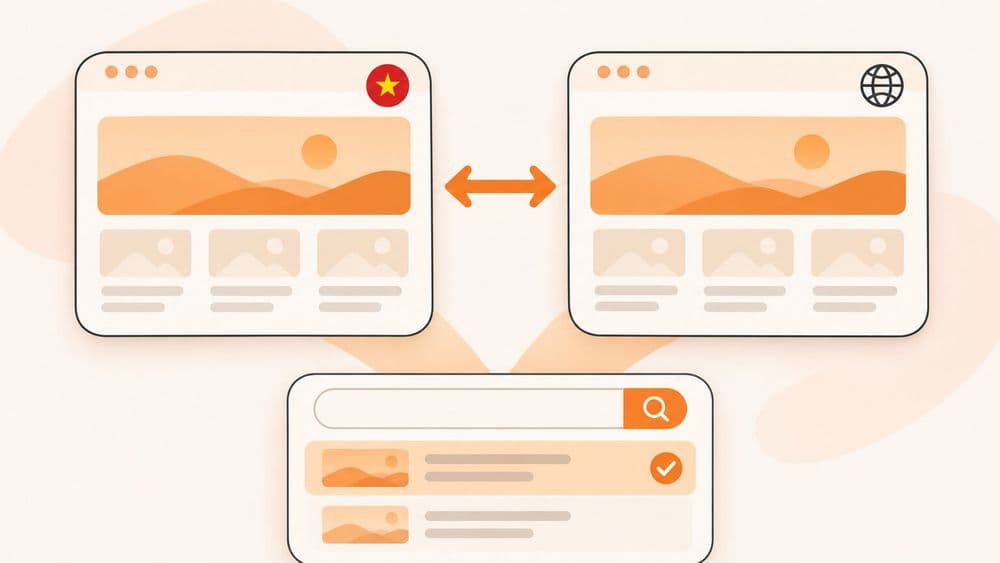
How hreflang, canonical URLs and language-aware sitemaps keep each language of your site in the right search results, and how to check your own site.
Picture a manufacturer in Long An that wants buyers overseas. It pays for an English version of its website. Months later, a buyer in Singapore searches in English for exactly what the factory makes. Google shows the Vietnamese page. Or it shows nothing from the site at all.
Many Vietnamese businesses add English pages for a reason that matters to revenue: a manufacturer selling to foreign buyers, a clinic serving expats, a distributor whose partners read English, a hotel taking bookings from abroad. The English pages are meant to bring in a different set of customers. Adding the translation is the easy part. Getting Google to show the right language to the right person is where most two-language sites fall short.
The symptoms tend to look like this:
Each of these quietly cancels the money you spent on translation. The English pages exist, but the buyers they were written for cannot find them.
The fix is a set of signals most visitors never see: hreflang tags, canonical URLs, language-aware sitemap entries and a separate address for each language. When they are right, Google can index every language and show each searcher the version in their language.
On a LaPage website, multi-language support is part of the codebase every site is built on, not a plugin added later. Everything below is set on every page, in every language, alongside the rest of the technical SEO groundwork.
Each language has its own URL, such as /en/services/... for English and the Vietnamese page at its own path. Page slugs are translated too, so the address itself reads naturally in each language.
There is no automatic redirect based on browser language. Visitors and crawlers see the page they asked for, and a clear language switcher lets people change. This is what lets Google crawl every version.
Every page carries hreflang tags for each language plus an x-default. In plain terms, each page lists all its language versions and names a default for searchers whose language you do not offer.
Each language also gets its own canonical URL. The English page points to itself as the real English page, so Google does not treat it as a duplicate of the Vietnamese one.
In the sitemap, each page appears with every language version listed beside it, so Google finds all of them, not just the main one. When you publish a blog post with a translation, both versions join the sitemap automatically. The llms.txt index is built in each language as well, so AI tools see your English and Vietnamese pages as one organised site.
Image alt text is written in each language, so your images can be found in Google Images by searchers in each language. Titles, descriptions and structured data are set per language too, so the search result itself appears in the searcher's language.
An extra language is a quoted add-on; whichever languages your site has, each one gets this same setup.
Multi-language SEO is where approaches differ most.
An AI website builder can usually translate a page quickly, but hreflang, a canonical per language and a sitemap with language alternates are rarely all handled, and some builders switch language with scripts on a single address, which crawlers cannot follow. A freelancer often adds a translation plugin. Many plugins handle hreflang reasonably, but slugs often stay in one language, alt text is not translated, and the result depends on settings someone has to get right. A template theme may offer a language switcher that only changes the visible text, with no separate URL for Google to index.
If your second language is only for show, any of these is fine. If it is meant to bring in buyers, ask how each language will be indexed and how you can check.
hreflang. You should see one line per language plus one marked x-default. Check that each points to the right page, not the homepage.canonical. The English page's canonical should be the English URL, not the Vietnamese one.yourdomain.com/sitemap.xml and look for your English pages. On a well-set-up site, each entry lists its other language versions beside it.site:yourdomain.com/en (or whatever your English path is). If few or no English pages come up, they are not being indexed.Yes, an extra language is a quoted add-on, because it means more pages to translate and review. The technical setup comes with it: hreflang, canonical URLs and sitemap entries are the same for every language.
Not when they are set up properly. Each language has its own address, a canonical pointing to itself and hreflang tags linking the versions, which tells Google they are translations, not copies.
Because Google's crawler would then see only one language. We show each URL as requested and offer a clear language switcher, so every version can be indexed.
No. It makes sure your English pages can be found, indexed and shown to English searchers. Rankings still depend on the content and the competition.
Send us your website and we will include a language check in a short audit with your free demo, so you know whether your English pages can be found.
LaPage Digital publishes systems-focused writing on architecture, automation, infrastructure, and operational delivery.


Subscribe to our newsletter to receive technical insights and updates on best practices for web development and hosting infrastructure.