ROI & Efficiency Optimization
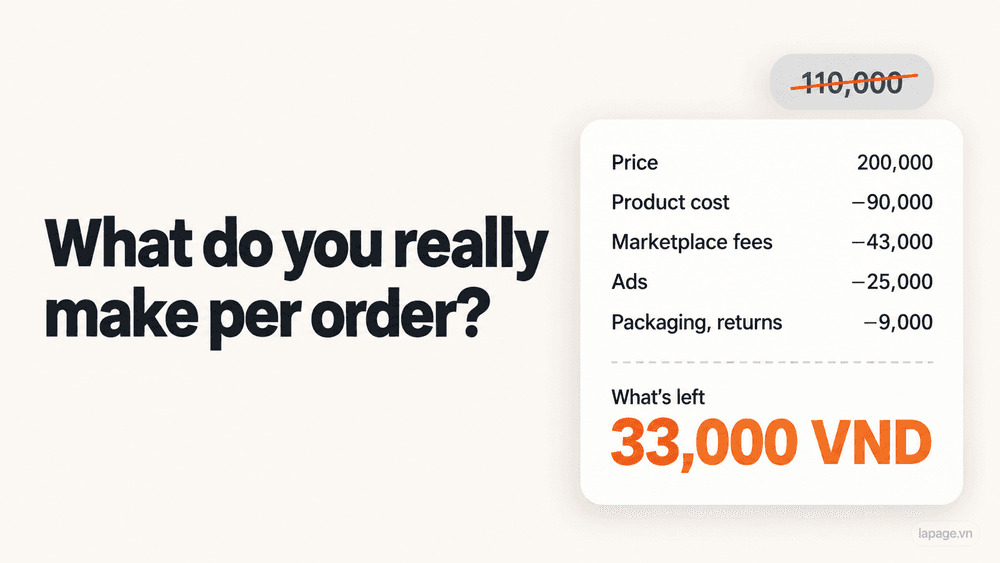
How much do you really make per order after marketplace fees and ads?
Oct 17, 2026 · 13 min read
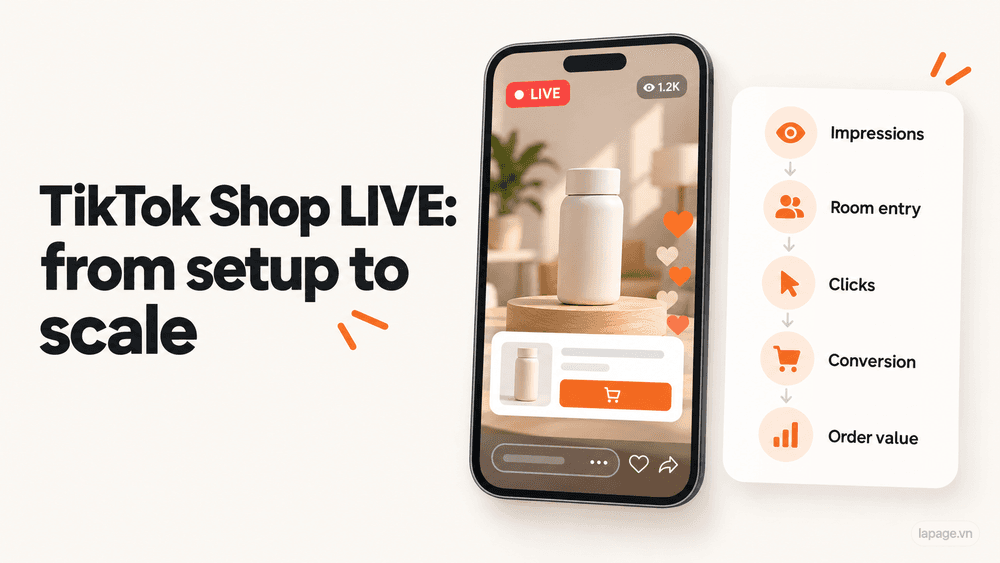
A TikTok Shop LIVE guide that follows the TikTok LIVE Playbook: 4 product roles, choosing hosts by numbers, the 7 room elements, Live GMV Max and the golden hour, topping up budget before 60%, the 5 metrics with worked examples, and a monthly LIVE calendar. Includes a calculator to compare two LIVE sessions.

The boss asks: "Is LIVE worth it? How do we make it bring in money, not just go LIVE for the sake of it?"
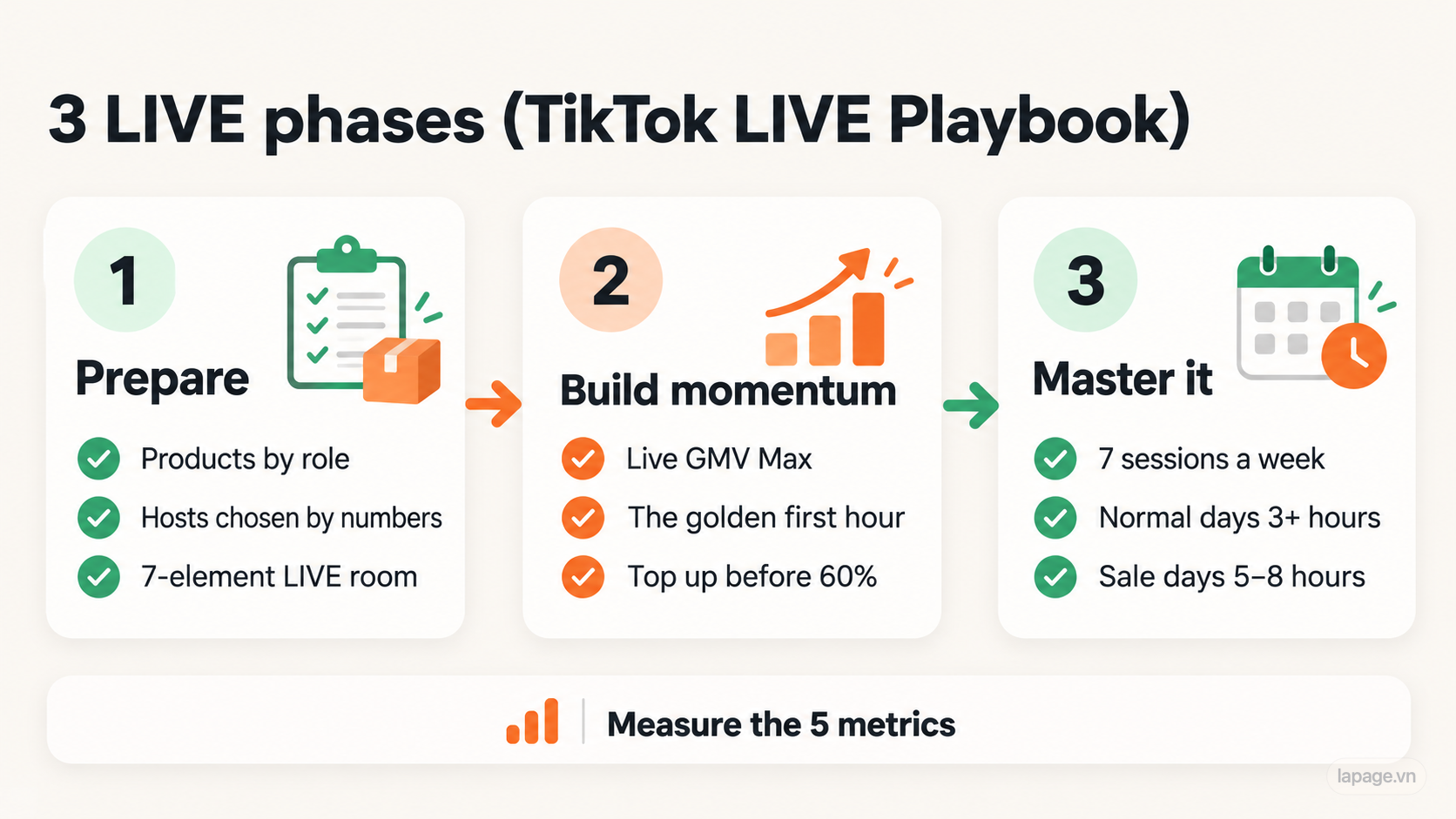
Almost every TikTok shop faces this question. Most advice online is loose tips: "go LIVE at golden hour", "buy decorations", "spend more on ads". This article takes a different route: it follows the logic of the TikTok LIVE Playbook, the guide TikTok uses to teach businesses how to sell through LIVE. That logic has 3 connected phases, plus one part many shops skip entirely: measuring the right metrics.
Author: Huy Lan, founder of LaPage Digital. Holds the TikTok Media Buying Professional certification issued by TikTok (valid until October 2027) and has hands-on experience analysing TikTok advertising data for major brands in the region. Figures marked "per TikTok" come from the TikTok LIVE Playbook; worked calculations are LaPage's illustrative examples.

Per the TikTok LIVE Playbook:
But the good numbers only come when you do things in the right order. TikTok splits it into 3 phases:
Running through all three are 5 metrics that tell you where a session is weak.
Don't put everything you sell into a LIVE. TikTok groups products into 4 roles based on two things: conversion rate (easy to sell or not) and profit margin (how much you make).
| Role | Conversion | Margin | Used to |
|---|---|---|---|
| Hero product | High | High | Generate most of the revenue |
| Traffic driver | High | Low | Attract viewers and lead them to hero products |
| High-margin product | Lower | High | Lift profit |
| Regular product | Low | Low | Make the shop feel complete |
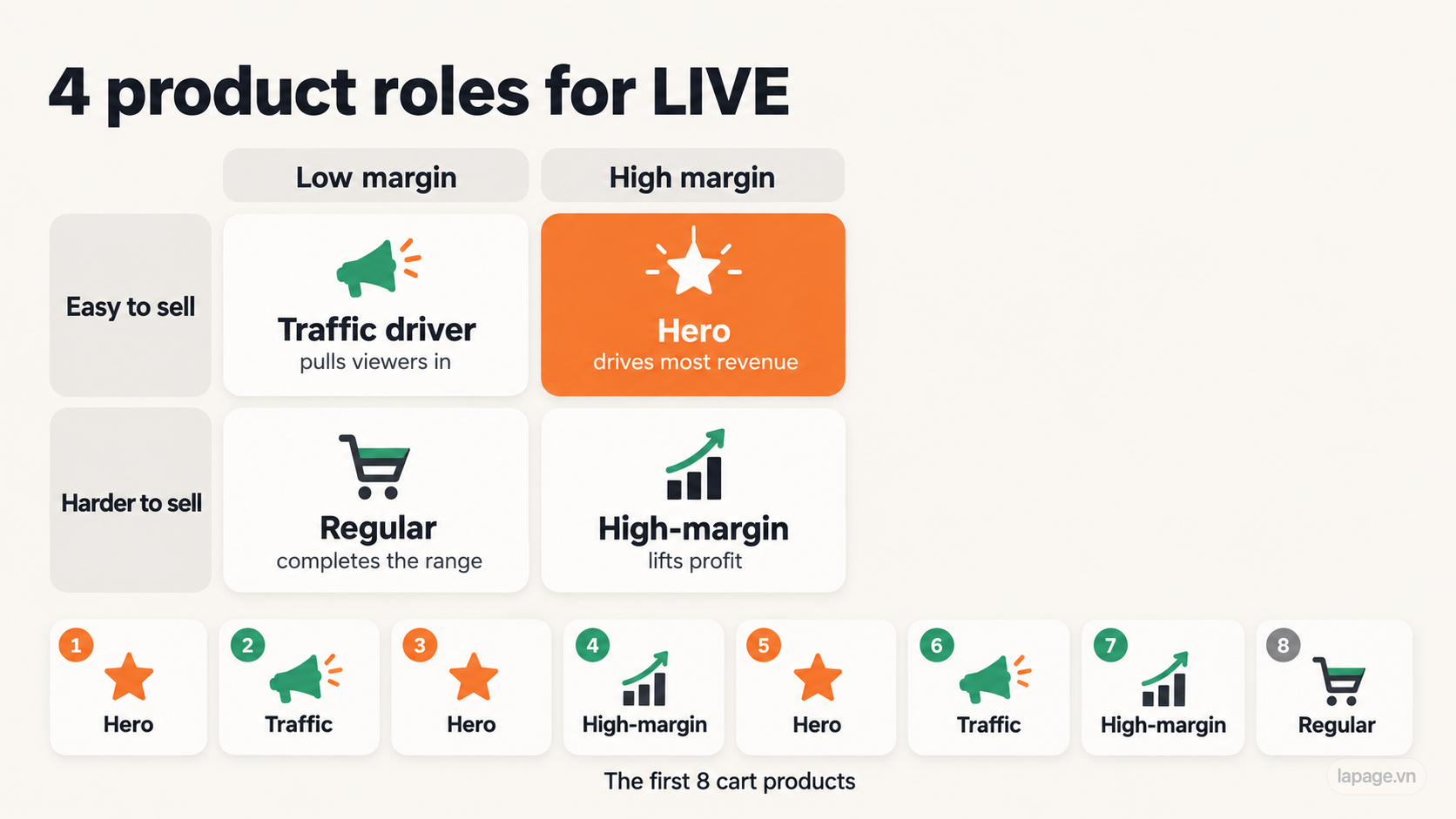
The first 8 products in the cart matter most, because viewers see all 8 in a single swipe. TikTok suggests alternating: hero → traffic driver → hero → high-margin, repeat, and put regular products last. Per TikTok, arranging the cart this way raises product click rate by 78%.
A great host isn't the best talker, but the one who keeps viewers and sells. TikTok evaluates hosts on 4 metrics:
| Group | Metric | What it tells you |
|---|---|---|
| Sales | Conversion rate (CVR) | Does the host turn viewers into buyers? |
| Sales | GMV per hour (GMV/h) | How much revenue each LIVE hour brings |
| Engagement | Room-entry rate (ERR) | Does the host pull people scrolling past into the room? |
| Engagement | Average watch time | Do viewers stay? |
Illustrative example: a shop has two hosts.
Binh is fun and draws people in, but doesn't close sales. An sells far better. Following TikTok's advice, An should take the busiest time slot. Per TikTok, putting the best host in peak hours delivers 1.8× the GMV. Binh can take other slots, or support An by keeping the energy up.
The team should grow with LIVE revenue: at first you need a host, an in-room assistant (handing products, reading comments) and an operator (cart, ads, orders); as LIVE revenue grows, add people for content, customer care and ads.
Someone scrolling past looks at a LIVE room for a few seconds before deciding to enter or move on. TikTok lists 7 elements:
Match the style to the category: beauty usually uses a clean, bright background; fashion needs warm, bright lighting for try-ons; home goods work best in a real-use setting; food suits occasion-based setups.
Inviting creators/affiliates to go LIVE brings orders fast. Per TikTok, shops working with affiliates have almost 3× the monthly LIVE GMV. But TikTok also says your own LIVE is the long-term strategy, because you build your own team, learn how the algorithm distributes your room, and own your customer data. Affiliates are a shortcut to get started; your own LIVE is an asset.
Once products, hosts and the room are in place, ads start to pay off. For LIVE, the main tool is Live GMV Max.
Per TikTok, only about 2% of paid viewers overlap with organic viewers, so ads bring almost entirely new people. Sessions with ads generate 149% more GMV than sessions without.
Example: a LIVE revenue target of 300 million VND a month → a LIVE ad budget of at least 30 million a month, about 1 million per LIVE day.
The first hour of a session decides much of the viewership that follows. TikTok advises:
Example: a 1 million VND daily budget → top up once about 600,000 is spent, not at 900,000.
Per TikTok, sessions that keep ads running the whole time get 40% more views per hour and 33% more GMV per hour than sessions that switch ads on and off.
Sale days: turn on Promotion Day Mode. It lowers the ROI target by at least 10% so ads deliver more widely; per TikTok, total GMV rises 47%. Don't do the opposite and raise your ROI target on sale days.
A real case TikTok shared: sunscreen brand Anessa in Vietnam applied these steps and gained 127% more impressions per hour and 56% more GMV per hour.
LIVE ads need videos to bring people into the room. There are two ways: clip the LIVE itself in real time (live-to-live), or make separate short videos (video-to-live). For video-to-live, per TikTok:
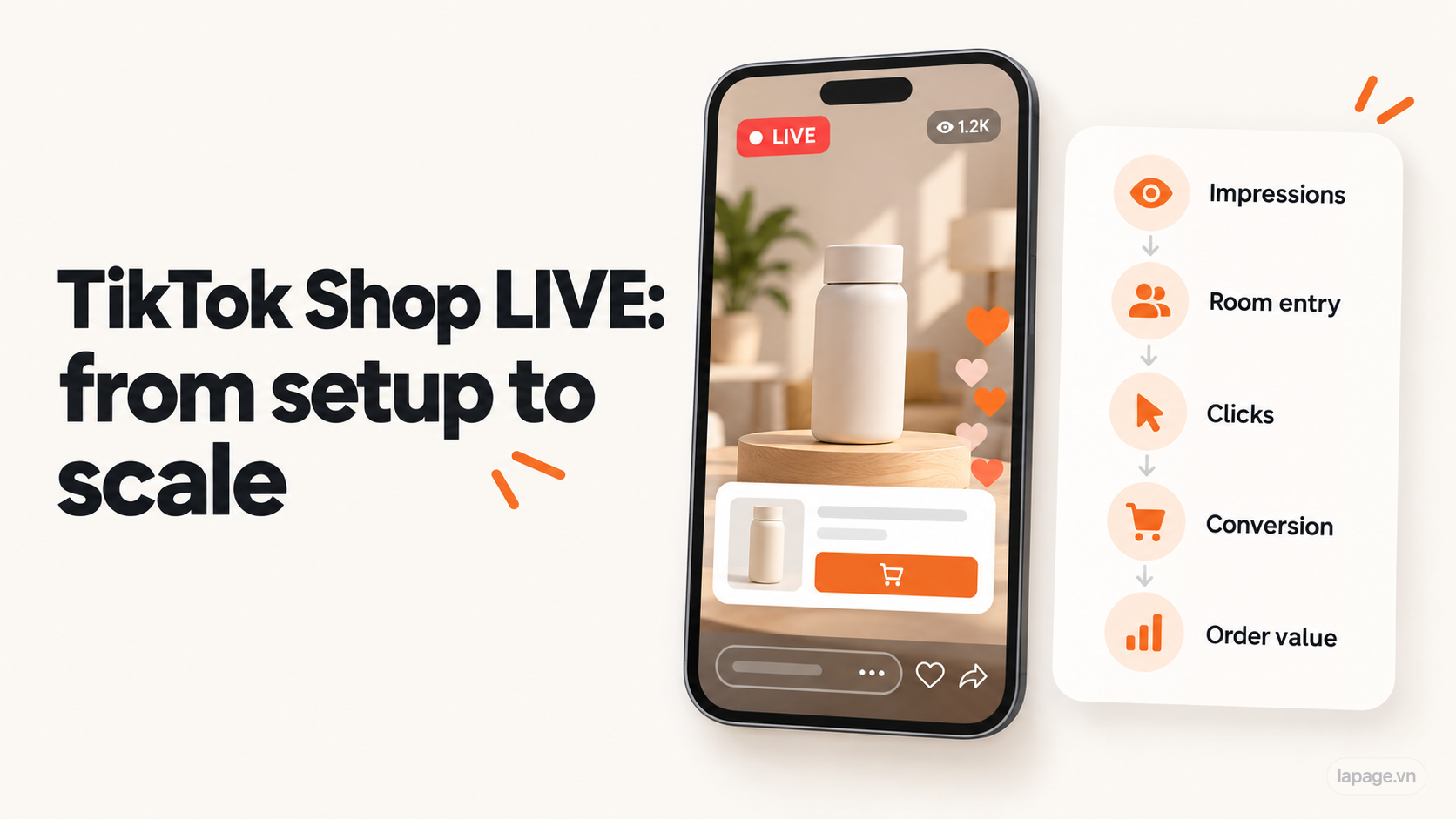
This is the part many shops skip. A session's revenue isn't one number; it's the product of 5 numbers:
LIVE revenue (GMV) = Impressions (Show PV) × Room-entry rate (ERR) × Product click rate (CTR) × Click-to-order rate (CTOR) × Average order value (AOV)
| Metric | How it's calculated | Tells you | To improve it |
|---|---|---|---|
| Impressions (Show PV) | Times your LIVE room was shown to viewers | Whether the room is being distributed | Go LIVE long enough, at the right time, ads on from the start, promo videos |
| Room-entry rate (ERR) | Entries ÷ impressions | Whether the frame makes scrollers stop | The 7 room elements, the offer shown on screen |
| Product click rate (CTR) | Product clicks ÷ entries | Whether viewers care about the products | A script with hooks, the first 8 cart products, the host holding products |
| Click-to-order rate (CTOR) | Orders ÷ clicks | Whether price and offer close the sale | Closing offers, flash sales, gifts |
| Average order value (AOV) | Revenue ÷ orders | How much each buyer spends | Bundles, add-ons |
Two more metrics for comparing sessions: GMV per hour (revenue ÷ LIVE hours) and average watch time (how long viewers stay).
| Step | Number | Result |
|---|---|---|
| Impressions | 120,000 | |
| Room-entry rate | 6% | 7,200 room entries |
| Product click rate | 10% | 720 clicks |
| Conversion rate | 6% | 43 orders |
| Average order value | 280,000 VND | Revenue ≈ 12M VND, GMV ≈ 4M VND per hour |
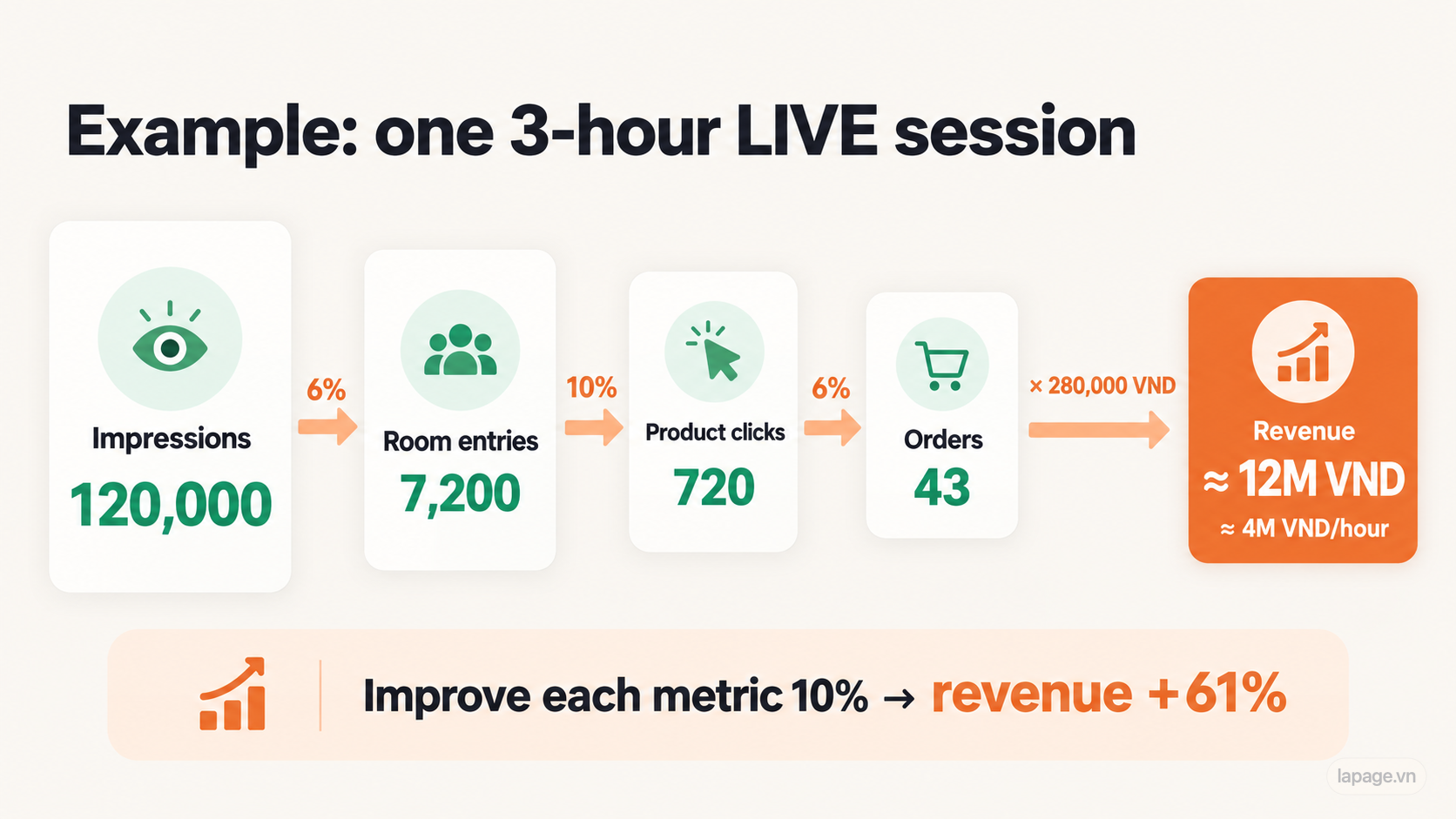
The next day's session gets 150,000 impressions, 25% more. But revenue is only about 7.5M VND. Compare each metric:
| Metric | Yesterday | Today |
|---|---|---|
| Impressions | 120,000 | 150,000 |
| Room-entry rate (ERR) | 6% | 3% |
| Product click rate | 10% | 10% |
| Conversion rate | 6% | 6% |
| Order value | 280,000 VND | 280,000 VND |
| Revenue | ≈ 12M VND | ≈ 7.5M VND |
The problem is the room-entry rate, not the ads or the host's closing. Maybe today's room didn't show the offer on screen, the lighting was poor, or the first 5 seconds gave scrollers no reason to stop. Spending more on ads now only raises impressions, which wastes even more.
Because small improvements to each metric compound fast. Raise every metric by 10% and revenue rises 61% (1.1 × 1.1 × 1.1 × 1.1 × 1.1 ≈ 1.61). That's usually much easier than trying to double a single metric.
A real example TikTok shared on the power of engagement: when a shop raised its giveaways to about one every 20 minutes (6 in 2 hours versus 2 in 1 hour), average watch time rose from 14 to 23 seconds, room-entry rate rose 81%, and GMV was 5.6× higher.
Enter the numbers from two LIVE sessions (from TikTok Shop's LIVE analytics). The calculator shows the stage with the biggest gap and how to fix it, plus an ad-budget estimate. Everything runs in your browser; nothing is saved or sent anywhere.
Per TikTok:
How many viewers TikTok sends to your LIVE room depends on two things:
A shop that only goes LIVE on sale days and then pauses for ten days has low 180-day LIVE revenue, so its next sale day gets less distribution. Per TikTok, shops that combine steady normal-day LIVEs with sale days grow steadily, while shops that only go LIVE on sale days stay roughly flat.
One more overlooked opportunity: right after a double day, many shops stop going LIVE while viewership stays high, so it's the easiest time to win viewers.
| Period | Length | Per session | Budget |
|---|---|---|---|
| Start of month, normal days | 2–3 days | 3 hours | ~7% |
| Warm-up before the double day | 2 days | ||
| Double day (e.g. 11.11) | ~5 days | 5–8 hours | ~34% |
| Mid-month | ~10 days | 3 hours | ~22% |
| Warm-up before payday | 2 days | ||
| Payday (end of month) | ~5 days | 5–8 hours | ~26% |
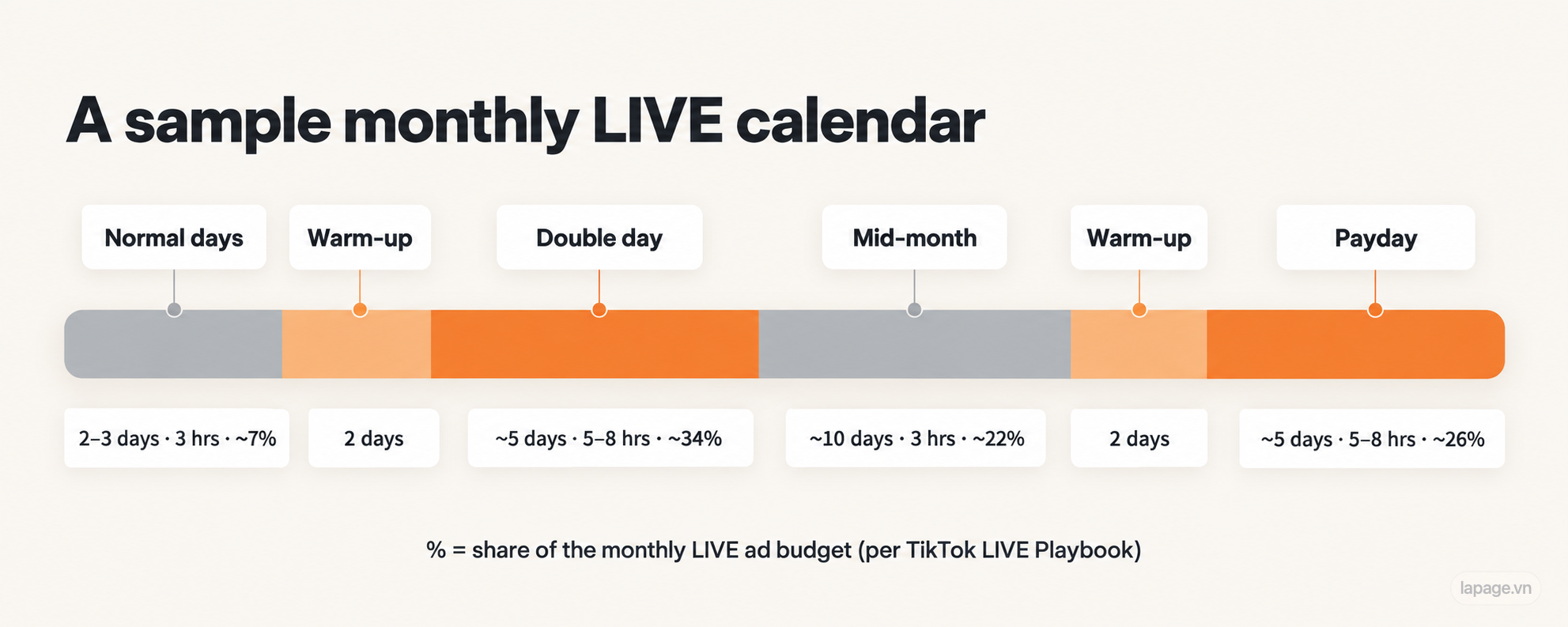
Normal days can follow a recurring theme (e.g. "Crazy Friday"), a members' day to bring back past customers, or official TikTok Shop campaigns.
High-revenue LIVE shops should combine brand ads with sales ads instead of running only conversion ads (TikTok suggests roughly 30% brand on normal days, 50% during sales, 20% after), and use Consideration Ads to reach people who've shown interest (searches, product clicks, engagement).
LIVE brings many new buyers, but they're customers on TikTok. Use the LIVE itself to invite them into a Zalo group or offer a next-purchase deal through your own channel. As How much do you really make per order after marketplace fees and ads? worked out, a returning customer through your own channel can earn twice as much as a new order through the marketplace and ads.
Which of the 5 metrics is weakest in your latest LIVE? Tell LaPage.
Founder of LaPage Digital, a Vietnam-based digital infrastructure and automation company founded in 2018. Huy Lan is a former Data Engineer at Publicis, where he managed data infrastructure for clients across the APMEA region. He focuses on helping businesses build reliable systems, own their data, and automate operations with practical, maintainable technology.
Subscribe to our newsletter to receive technical insights and updates on best practices for web development and hosting infrastructure.