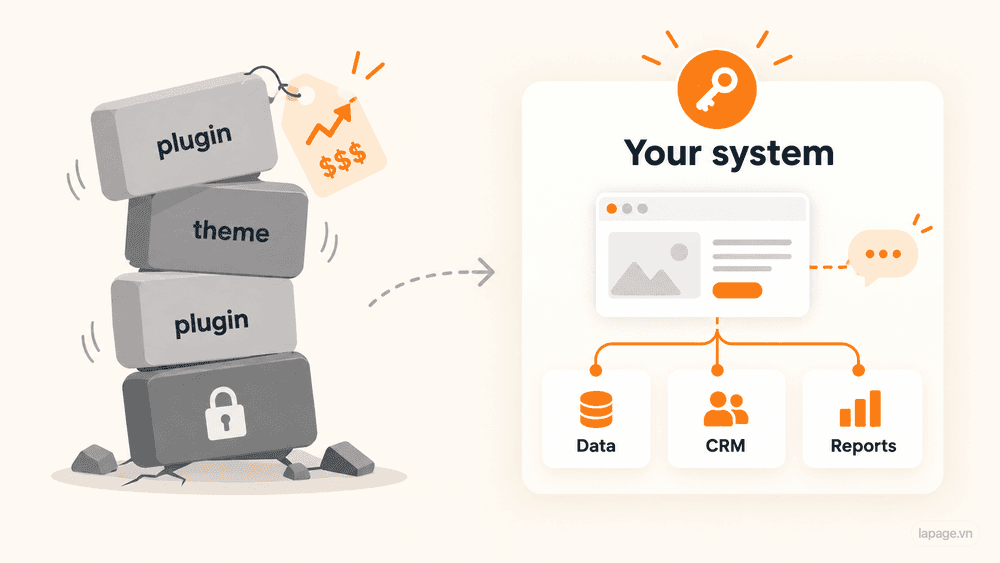
Company Website
Should You Migrate Your Website From WordPress to Next.js? Ask Who Controls It First
Oct 14, 2026 · 12 min read
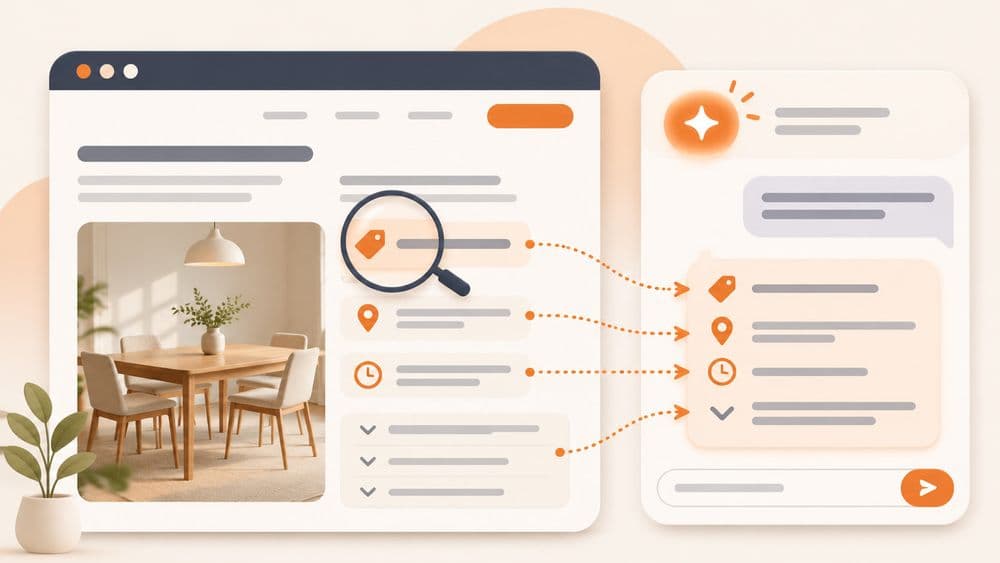
In the AI era your website needs more care: AI reads it to describe your business to customers. A real Google example, and 6 GEO basics: metadata, structured data, each language, consistent facts, content that answers real questions, and not blocking AI crawlers.
Lately we hear the same line everywhere: "We have AI now. Who still needs a website?"
It sounds reasonable. Customers no longer type a search into Google and click through links. They ask ChatGPT, Gemini or Perplexity directly: "Who makes good custom furniture in Thu Duc?", "Where can I buy sewing machine parts at a fair price?". The AI answers in one tidy paragraph, and the customer picks from it.
But where does that answer come from? The AI doesn't know what you sell, what it costs or when you open. It reads the web, and if you do it right, the clearest and most complete source about your business is your own website.
So we think the opposite is true: in the AI era, your website matters more than ever, and it needs more care, not less.
Search Google for "Huy Lan LaPage" and the AI Overview writes a short profile on its own: who founded LaPage, what the company does, its address, tax code and the founder's previous work. Almost word for word correct.
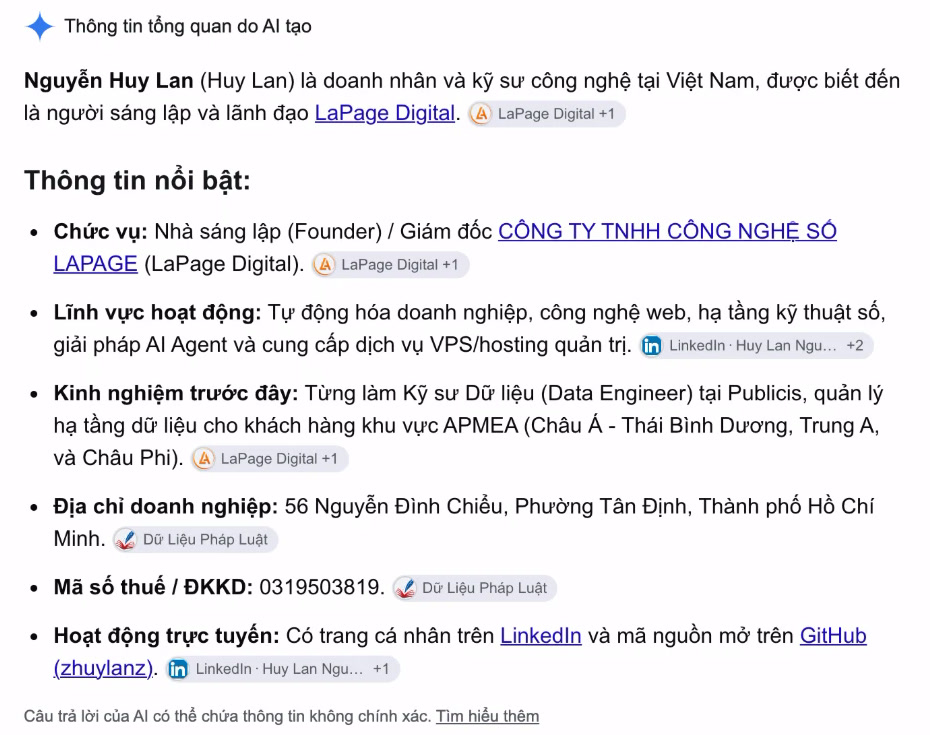
Look at the sources the AI shows next to each point: the LaPage Digital website, LinkedIn, and a public business registry page. The AI knows nothing special about us. It pieces the answer together from sources that are clear and agree with each other. That is the whole point of this article.
Imagine a customer asks an AI about your bakery and gets this:
"According to their website, a birthday cake costs 150,000 VND, the hotline is 'coming soon', and the shop is closed for Tet until the 10th day of the new year, 2023."
The AI isn't lying. It is reading, very diligently, a website nobody has touched in years. Old price list, empty phone number, a holiday notice from two years ago: the AI repeats all of it, with total confidence.
And when your website is vague, saying only "We provide comprehensive, top-quality solutions", the AI has to guess. AI guesses can be quite creative. Worse, it may skip you and recommend a competitor, simply because their website is clearer.
A few years ago, a beautiful website was a real advantage. Today AI can build a polished-looking design in an afternoon. Pretty is no longer rare.
What is still hard, and worth more every month, is the part nobody sees: content that is correct, clear and consistent, written so that both people and machines understand it. We used to write for Google. Now we also write for AI assistants. This has a name: GEO (Generative Engine Optimization), making your website easy for AI tools to understand and describe correctly.
Nobody can promise that AI will always recommend you. But you do decide what the AI finds when it reads your website. That is the part we take care of.
Every page needs its own title and short description (metadata) saying exactly what the page is, what it sells and who it is for. Not every page called "Home", not every description a company slogan.
For example, instead of "Products | ABC Company", write "6-seat solid oak dining table, delivered and assembled in Ho Chi Minh City | ABC Furniture". Google and AI read this line first.
Structured data is a small block of code in the page that states, in a shared standard (schema.org): this is the business name, this is a product, this is the price, the address, the opening hours, these are the frequently asked questions. Visitors don't see it, but machines understand it at once instead of guessing from a long paragraph.
If your website has an English version, it should be written for English readers, not pasted from Google Translate. An AI reading a machine translation understands it about as well as a person does.
Each language version should also be declared (hreflang tags), so search engines know which page is the Vietnamese and which is the English version of the same content, and show the right one to the right person.
Name, address, phone number, opening hours and prices should match on your website, Google Maps, Facebook and marketplaces. If your website says you open at 8 and Google Maps says 9, the AI doesn't know which to trust, and neither do customers.
Make your website the source of truth. Change things there first, then update everywhere else.
Customers don't ask AI about "comprehensive interior solutions". They ask "how much is a laminate kitchen cabinet" or "do you deliver to Thu Duc". If your website answers exactly those questions, on product pages or an FAQ page, the AI has something to quote.
The easiest way to find those questions: reread the last three months of customer messages on Zalo and Facebook.
Some websites accidentally block crawlers in robots.txt, or only show content after JavaScript runs. Many AI crawlers don't run JavaScript the way a browser does, so they see an empty page.
Check that robots.txt doesn't block AI search crawlers (for example ChatGPT's OAI-SearchBot and PerplexityBot), that your main content is in the HTML, and that pages load fast on a phone.
Fanpages, marketplace shops and TikTok accounts are useful, but they are rented space. When the platform changes its rules, you follow. Your website is the one place where you fully decide what to say, when to update it, and what AI can read about your business.
In the AI era, your website works like your business's official record: the place both customers and AI go to check who you really are, what you sell and what it costs.
Open ChatGPT or Gemini and ask:
Is the answer right? Does it mention you at all? Or is it being… creative? If the AI gets you wrong, your website is almost certainly missing or mixing up one of the 6 things above.
When LaPage builds a website, we don't stop at a good-looking design. Every site gets the 6 checks above: metadata on every page, structured data, each language written on its own, consistent facts, content that answers real customer questions, and the technical setup that lets both Google and AI read it. And the website is yours: domain, content and customer data.
If you want to see what your current website is telling AI about you, see LaPage's website service or send us a message.
LaPage Digital publishes systems-focused writing on architecture, automation, infrastructure, and operational delivery.
Subscribe to our newsletter to receive technical insights and updates on best practices for web development and hosting infrastructure.