AI Agents & Agentic Systems
How Codex Works: MCP Tools, Skills, and AGENTS.md
Aug 1, 2026 · 11 min read
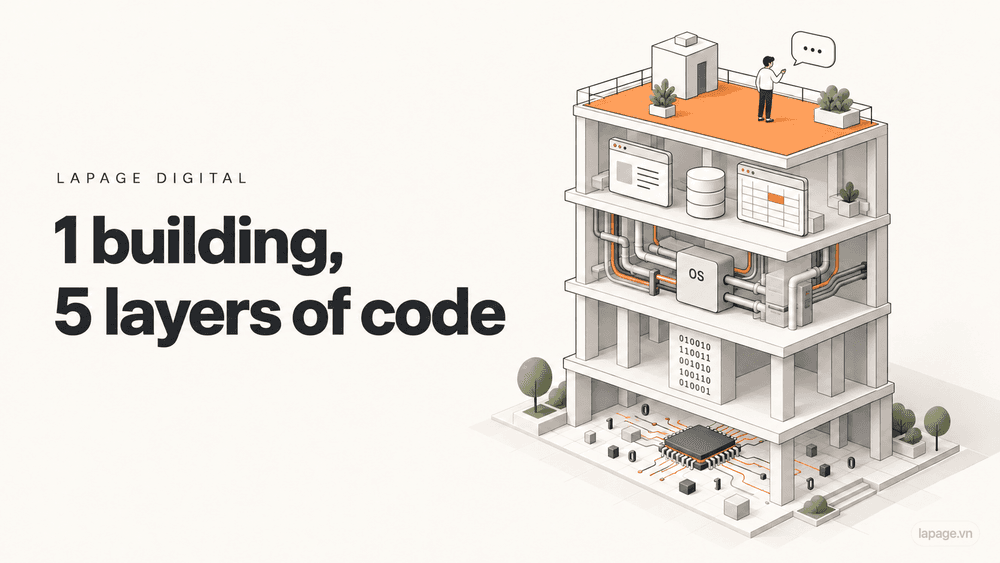
Why the world has thousands of programming languages, and why non-developers should still understand them: the 5-floor building of a computer, a summary table, and 4 ways to use this map to work with AI more effectively.

The newest programming language is plain English.
That sounds like a joke, but it isn't quite one. In early 2023, Andrej Karpathy, one of OpenAI's founding members, wrote that "the hottest new programming language is English." His point: you can now describe what you want in ordinary language, and AI writes the code. For a Vietnamese business owner, the same is true of Vietnamese.
In early 2024, Nvidia CEO Jensen Huang went further: the tech industry's job is to make computing so easy that nobody has to program, and the programming language becomes human language.
Many people concluded that there's no need to learn to code anymore. That is half true.
You don't need to memorize syntax or remember where every semicolon goes. But the better you understand how a computer works, the better you can hand work to AI. Think of building a house: you don't need to mix the concrete yourself, but an owner who knows where the foundation, the frame, the wiring and the plumbing are won't get a contractor "fixing" the wrong thing.
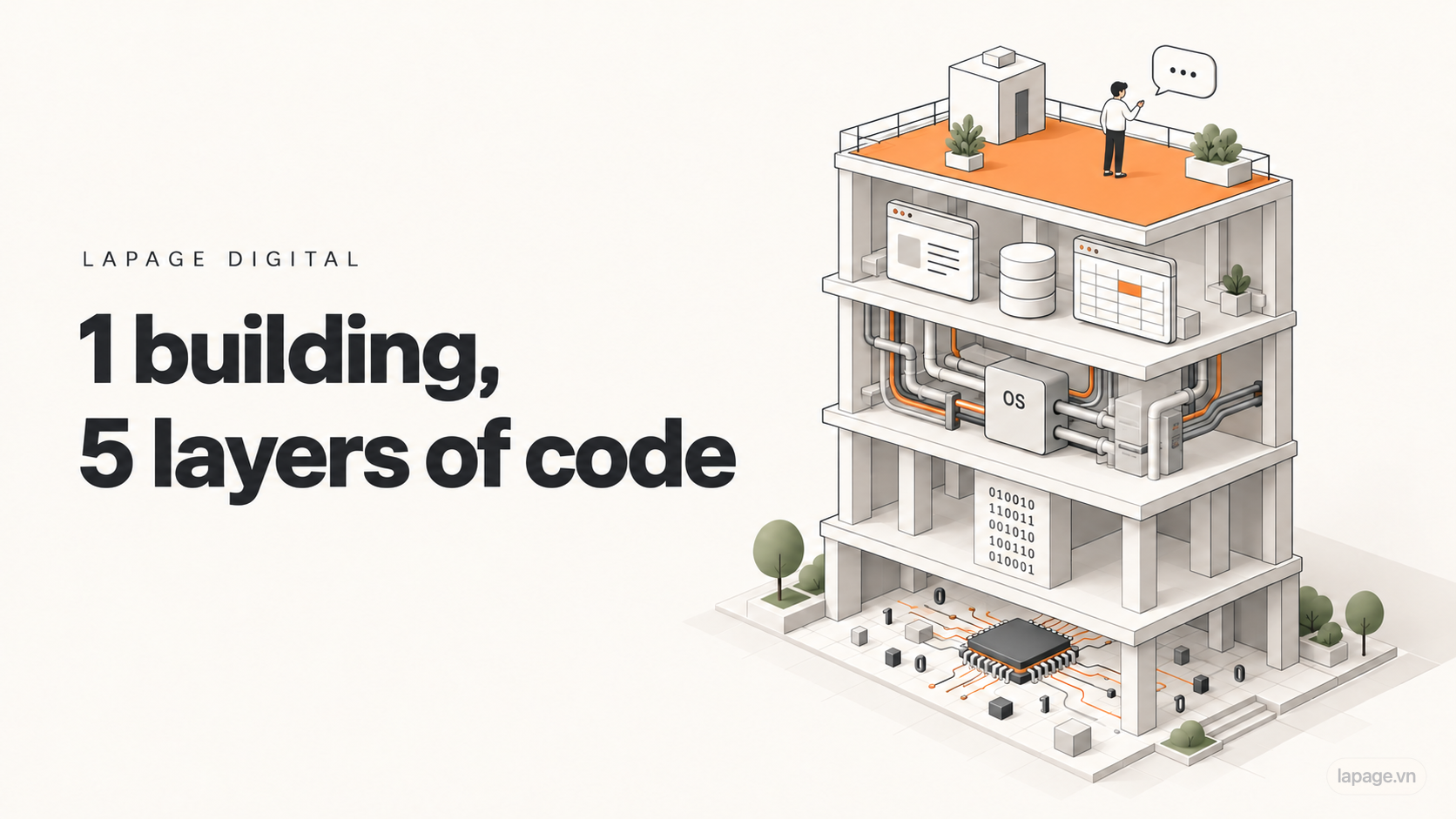
This article draws that map for you. Picture the computer as a 5-floor building. Each floor is one layer of the system, and each layer has its own languages. You won't need to read a single line of code.
People have created thousands of programming languages, although everyday software relies on a few dozen popular ones. There are three main reasons:
Now let's go from the ground up.
A modern chip contains billions, sometimes tens of billions, of transistors. Each transistor is a tiny switch: current on or current off, which is to say 1 or 0. Those two states are all a computer understands. Everything you see on screen, from a photo to a chat message, ends up as long strings of 0s and 1s.
There is no programming language on this floor yet. There is only electricity, circuits and physics. The people who work here are chip and hardware engineers.
A familiar example is overclocking a CPU. Gamers who want a faster machine don't write code. They go into the BIOS and adjust voltage and clock speed, which means working directly on the ground floor. You can only fix a problem once you know which floor it lives on. That is the core idea of this whole article.
A CPU can only run machine code: instructions written in 0s and 1s, along the lines of "take the number in this memory slot, add the number in that one, and store the result in a third." Almost nobody can write raw 0s and 1s, so each instruction got a memorable name: ADD to add, MOV to move data. That is Assembly.
Assembly is very fast and controls every step the chip takes. The price is that small tasks take a lot of writing: printing one line of text on screen can take a dozen instructions. Each chip family (Intel and AMD in computers, ARM in phones) also has its own Assembly, so code written for one doesn't run on another.
Today Assembly is mostly used where absolute precision matters: the code that boots a machine, parts of device drivers, and routines that need to be fast down to the microsecond. Almost nobody writes a whole application in it anymore.
In the early 1970s, Dennis Ritchie at Bell Labs created the C language, and he and his colleagues used it to rewrite the Unix operating system. That was a turning point: for the first time, an operating system wasn't tied to one kind of chip. You write it once in C, and a compiler translates it into machine code for each chip.
The operating system is the building's frame, wiring and plumbing. It shares out memory, manages storage, networking, the keyboard and the screen, and lets the applications on the floors above share those resources without stepping on each other. The cores of Windows, macOS, Linux and Android are written mostly in C and C++.
C has a weakness too: it gives programmers full control over memory, which makes mistakes easy. Microsoft has said that about 70% of the security vulnerabilities it fixes each year come from memory-safety bugs. That is why Rust was created, and since late 2022 it has been part of the Linux kernel. New languages are born to patch the weaknesses of old ones, exactly as the third reason above says.
When do you touch this floor? When you rent a server for your website: Linux or Windows, how much RAM, how much storage.
This is where most of the software you use every day is built, and it's the biggest reason there are so many languages. Each room has a purpose, and each purpose has a language that fits it best:
=SUMIF or =VLOOKUP, you've already programmed on this floor.Languages on this floor are easier to write because the floors below do the hard part. Python actually runs on a program written in C. Your browser runs JavaScript with an engine written in C++. Every floor stands on the shoulders of the one below it.
This is the newest floor. You don't write code, you say: "Build me an event sign-up page and save each guest's name and phone number to a spreadsheet."
AI translates that sentence into HTML, JavaScript and SQL on floor 4. That code is in turn translated down through floors 3 and 2, and finally becomes electric current flowing through transistors on floor 1.
Think of AI as a skilled general contractor: it listens to the owner in plain language, then directs the crews on every floor below. But even the best contractor needs the owner to be clear about which floor and which room to work on.
| Floor | In the building | In the computer | Languages | When you meet it |
|---|---|---|---|---|
| 1 | Ground | Hardware: chips, transistors | None yet, only electricity (1 and 0) | Choosing a computer or server |
| 2 | Foundation | Machine code | Assembly | Almost never |
| 3 | Frame, wiring, plumbing | Operating system | C, C++, Rust | Renting a server, installing software |
| 4 | Rooms | Websites, data, apps, automation | JavaScript, SQL, Python, Swift, Kotlin, Excel formulas | Building a website, reports, workflows |
| 5 | Rooftop | Talking to AI | Vietnamese, English | Every day |
You message an AI: "My website is too slow, fix it." The AI might rewrite the whole interface, which takes effort and leaves the site just as slow. Meanwhile, the usual causes are somewhere else: images that are too heavy, slow database queries, or an underpowered server.
Someone who understands the building would ask:
"The home page takes six seconds to load. Check the image sizes, the database query times and the server configuration. Tell me where the bottleneck is before you change anything."
It's the same AI, but the second request points straight at the three floors to check, so the answer is in the right place from the start.
However capable an AI is, it can't guess what your system looks like. Add one line such as "The website runs on WordPress, on a Linux server, with data in MySQL," and the AI knows which building it's in, which floor, and which languages to use. The answers get much more accurate.
AI sometimes proposes a bigger fix than the job needs: you want to change one button, and it suggests moving the whole platform. With the map in mind, you can see right away that "this job is inside one room; there's no need to knock down the frame."
Also remember: the lower the floor, the bigger the risk. A mistake in one room breaks one room. A mistake on the server or the operating system can affect the whole building. Work on the lower floors should have a backup and be reviewed by someone who knows what they're doing before it goes live.
Selling only on a marketplace or a rented platform is like renting a room in someone else's building. When they change the rules, raise fees or lock the door, you have to go along with it.
When you have your own website, your own customer data and your own workflows, you hold the keys to your own rooms. AI then works inside your system, the way you want, on data that belongs to you.
You don't need to learn to code to become a developer. But it's worth spending a few hours understanding the map of your own system:
A small tip: ask the AI itself. Paste in what you know about your system and ask: "Explain my website's system floor by floor, from the server to the interface, in plain language." AI is a very patient teacher for drawing this map.
AI has removed the hardest part of programming, which is remembering syntax. It hasn't removed the value of understanding the system. If anything, now that anyone can give AI instructions, the people who understand the building are the ones who point it at the right place.
Have you ever asked AI to fix something, only to have it fix the wrong thing? Tell LaPage about it.
Founder of LaPage Digital, a Vietnam-based digital infrastructure and automation company founded in 2018. Huy Lan is a former Data Engineer at Publicis, where he managed data infrastructure for clients across the APMEA region. He focuses on helping businesses build reliable systems, own their data, and automate operations with practical, maintainable technology.
Subscribe to our newsletter to receive technical insights and updates on best practices for web development and hosting infrastructure.