
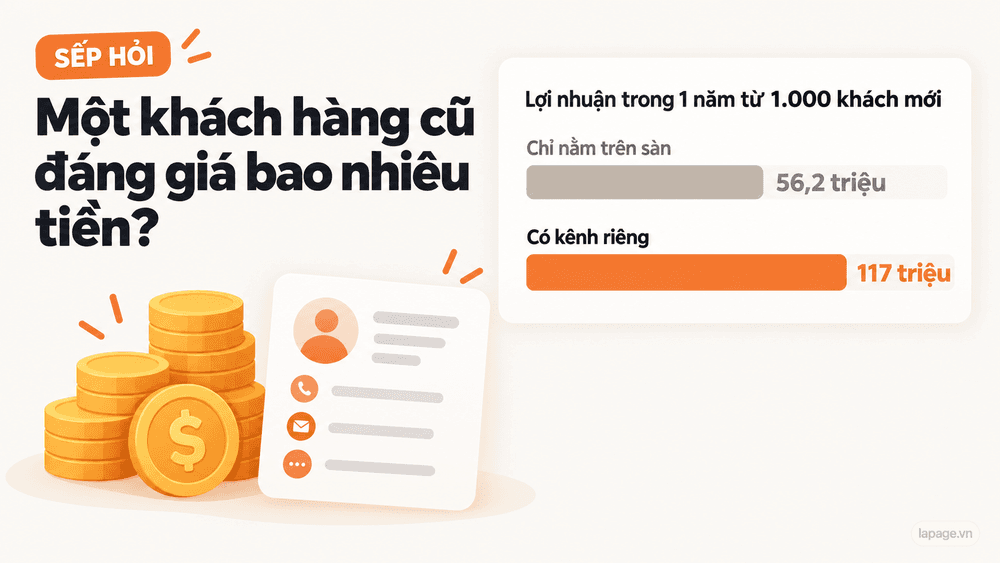
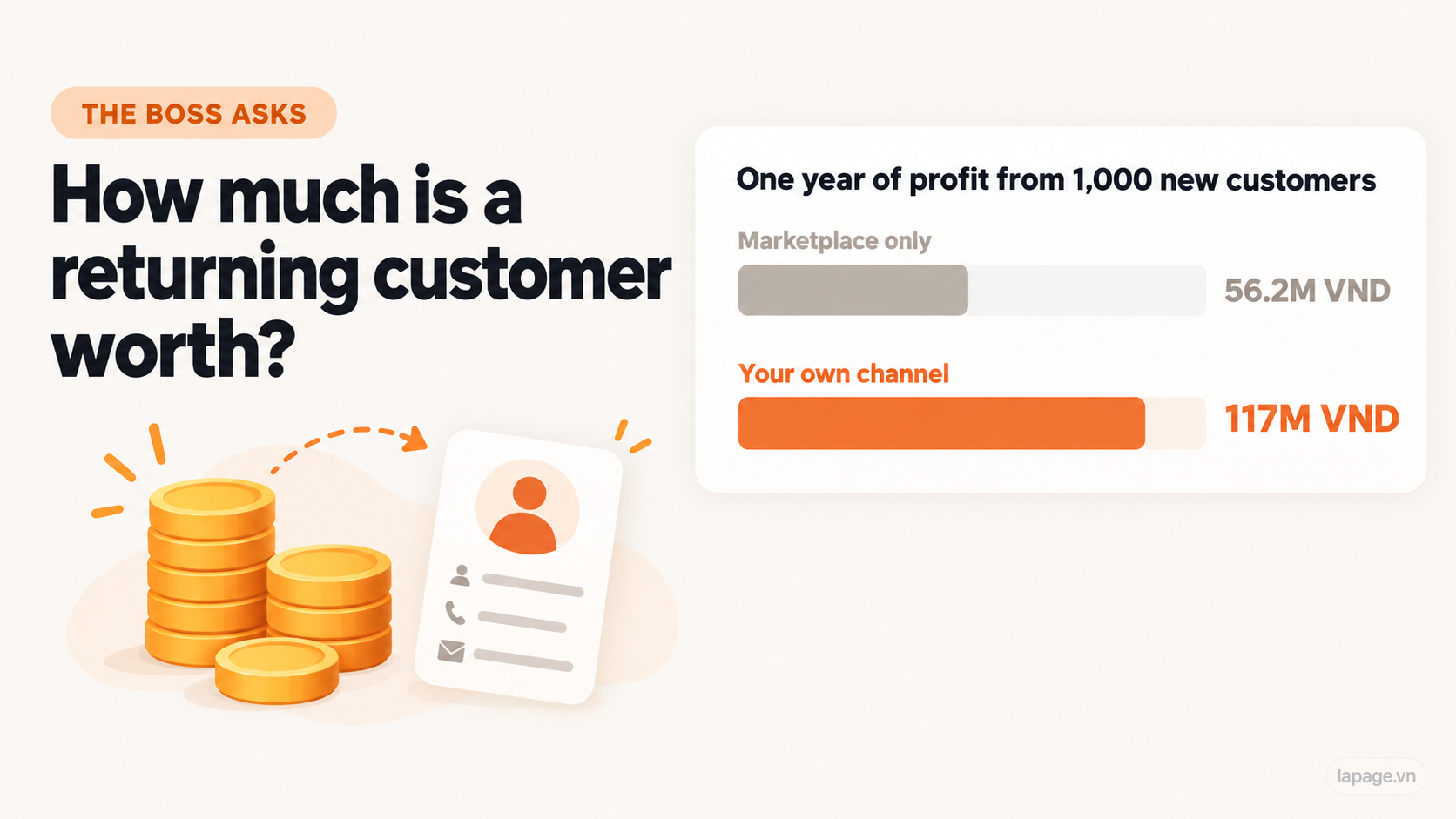
Your shop sells 1,000 orders a month on a marketplace. If your account were locked tomorrow, how many of those customers could you contact?
For many shops, the answer is: almost none. Customers bought from you, but their names, phone numbers and purchase history live on the marketplace. Next time they want to buy again, they open the app, search, and quite possibly click another shop whose ad sits above yours.
In early October, VnExpress reported that marketplace fees had gone up several times in 2026, and that about 90% of the marketplace sellers in one industry association said "the more we sell, the more we lose". Many shops are now trying to bring customers to their own channels: handwritten notes in parcels, invitations to message on Zalo, one brand offering up to 30% off for ordering directly on its website.
This article answers the question behind all of that: how much is a returning customer actually worth, and how do you keep them without breaking marketplace rules?
I'm using the approach I rely on when analyzing advertising data for large brands: look at what a customer is worth over a whole year, not just the profit on one order. The numbers below are illustrative examples, continuing the article How Much Do You Really Make per Order After Marketplace Fees and Ads?. At the end there's a calculator for your own shop's numbers.
One order, three different profits
Take the same 200,000 VND fashion order from the previous article, with a product cost of 90,000 VND. Same product, same price, but the profit depends heavily on where the customer comes from:
| Where the customer comes from | Marketplace fees | Ads | Shipping you cover | Profit per order |
|---|---|---|---|---|
| New customer, via marketplace and ads (ROAS 8) | −43,000 | −25,000 | 0 | 33,000 VND |
| Returning customer, finds your shop again on the marketplace | −43,000 | 0 | 0 | 58,000 VND |
| Returning customer, orders through your Zalo or website | 0 | 0 | −25,000 | 80,000 VND |
After product cost 90,000, packaging 5,000 and returns 4,000 VND (orders from regulars through your own channel have very few returns, so returns are counted as 0). The second row is the kindest case for the marketplace: the customer searches and finds your shop without clicking any ad.
For the same customer, a repeat order through your own channel earns about 2.4 times the first order. But profit per order isn't the biggest story.
The bigger story: does the customer come back at all?
The profit from one customer over a year works like this:
Customer value = First-order profit + Repeat orders × Profit per repeat order
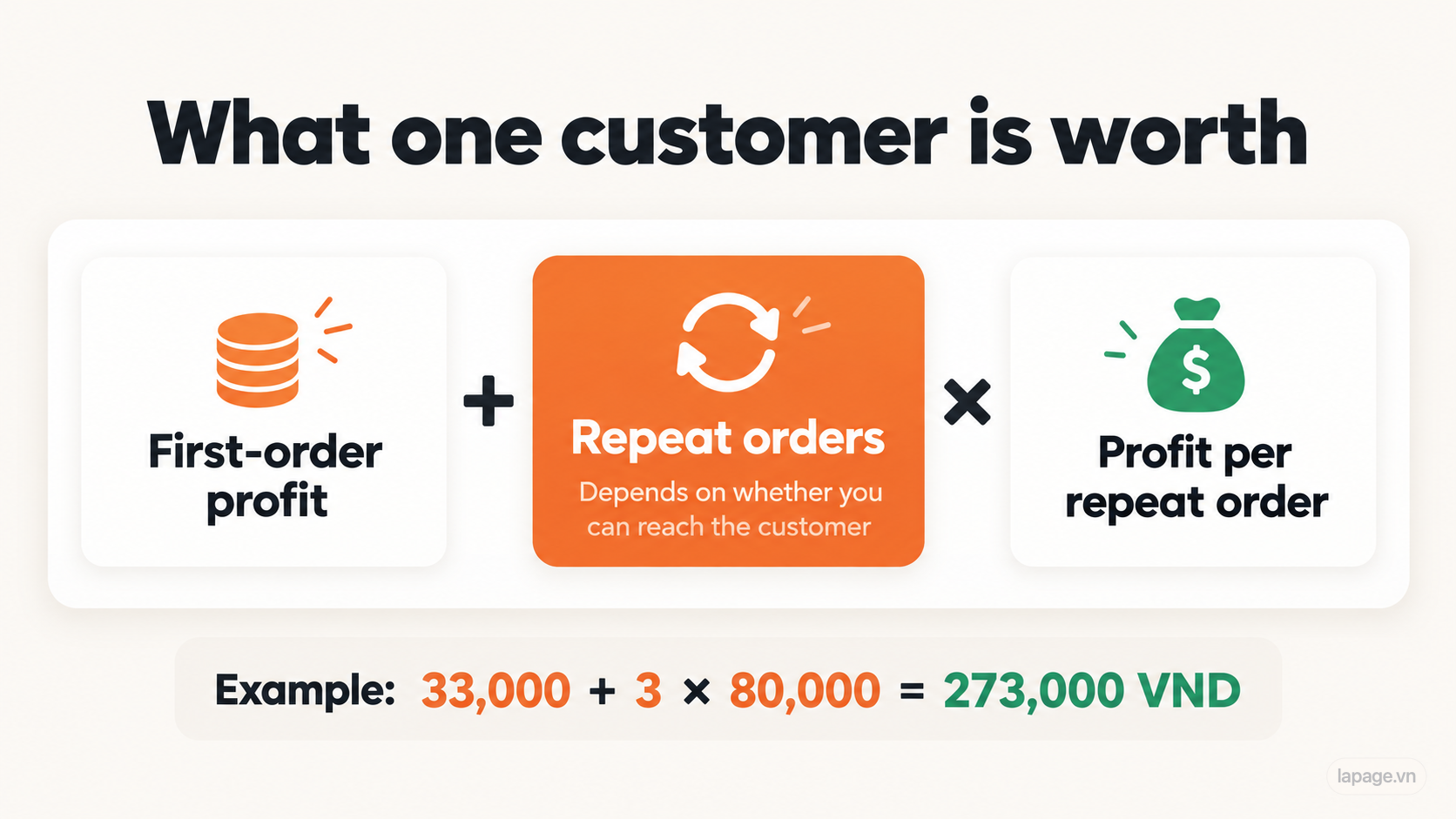
First-order profit is roughly fixed. What makes the difference is the number of repeat orders, and that depends on something very simple: whether you can remind the customer.
- Customers who only exist on the marketplace: you have no phone number, you can't message them about new arrivals, you can't wish them a happy birthday. Whether they come back depends on luck and the marketplace's algorithm.
- Customers on your own list: when a new collection drops, when what they bought is about to run out, when there's an offer for regulars, you send one message. Every reminder is a moment the customer remembers you.
Adding it up for 1,000 new customers over a year
Say your shop gains 1,000 new customers a month, and we follow those customers for the next 12 months:
| Marketplace only | Your own channel (Zalo, website) | |
|---|---|---|
| Profit from first orders | 1,000 × 33,000 = 33M VND | 1,000 × 33,000 = 33M VND |
| Share of customers who return | 20% | 35% |
| Repeat orders per returning customer | 2 per year | 3 per year |
| Repeat orders | 400 | 1,050 |
| Profit per repeat order | 58,000 VND | 80,000 VND |
| Profit from repeat orders | 23.2M VND | 84M VND |
| Total profit for the year | 56.2M VND | 117M VND |
| Average value per customer | about 56,000 VND | about 117,000 VND |
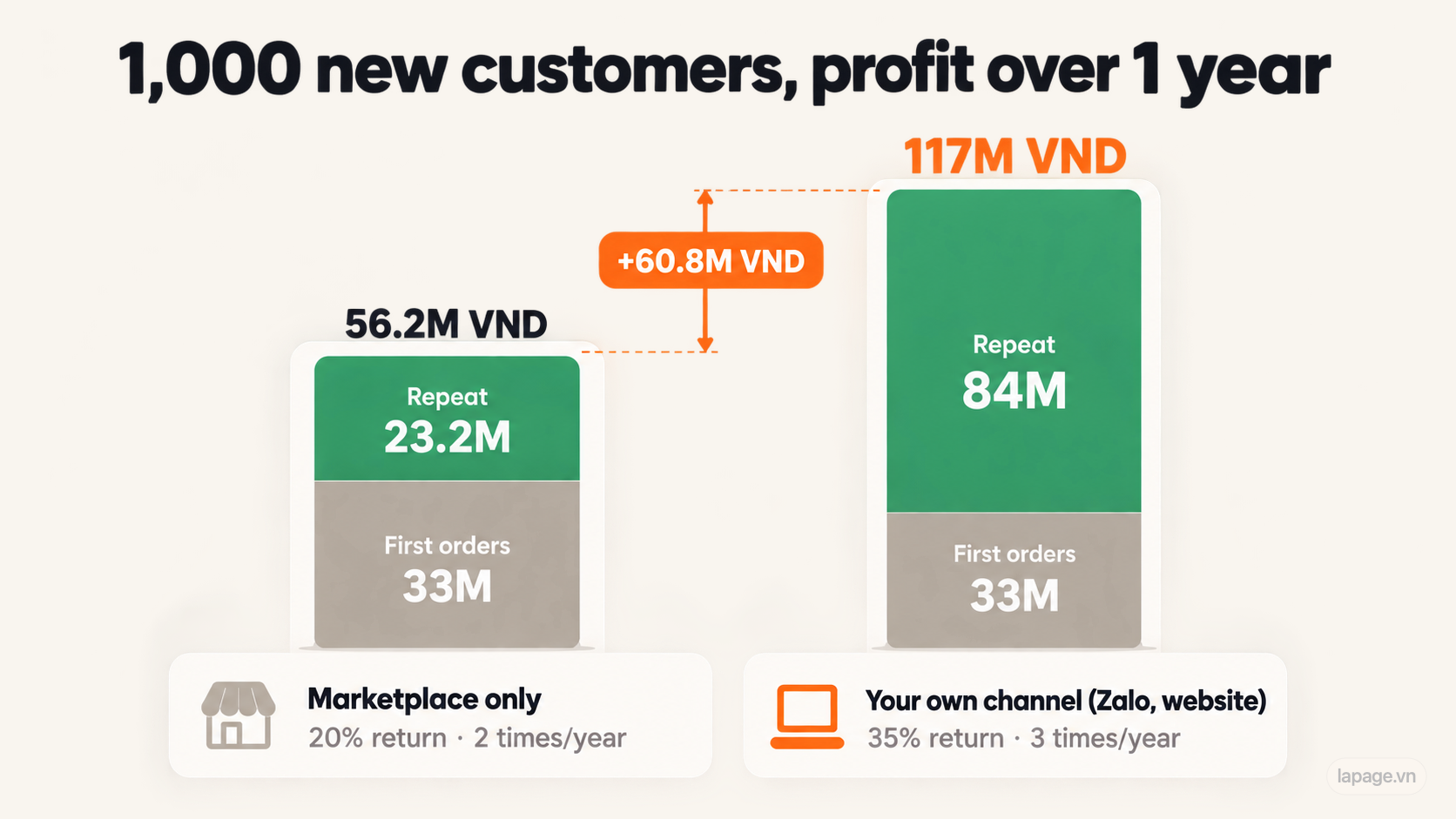
Same 1,000 customers, same ad spend to get them, yet profit differs by 60.8 million VND. And that's just one month of new customers. Across 12 months, the gap is over 700 million.
The 20% and 35% return rates are illustrative assumptions. Consumables (cosmetics, food, baby products) usually see more repeat buying; durable goods (furniture, appliances) less. Use the calculator at the end with your own numbers.
What would it cost to make up 60.8 million with new customers?
If you can't keep returning customers, the only way to earn that extra 60.8 million is to find more new ones:
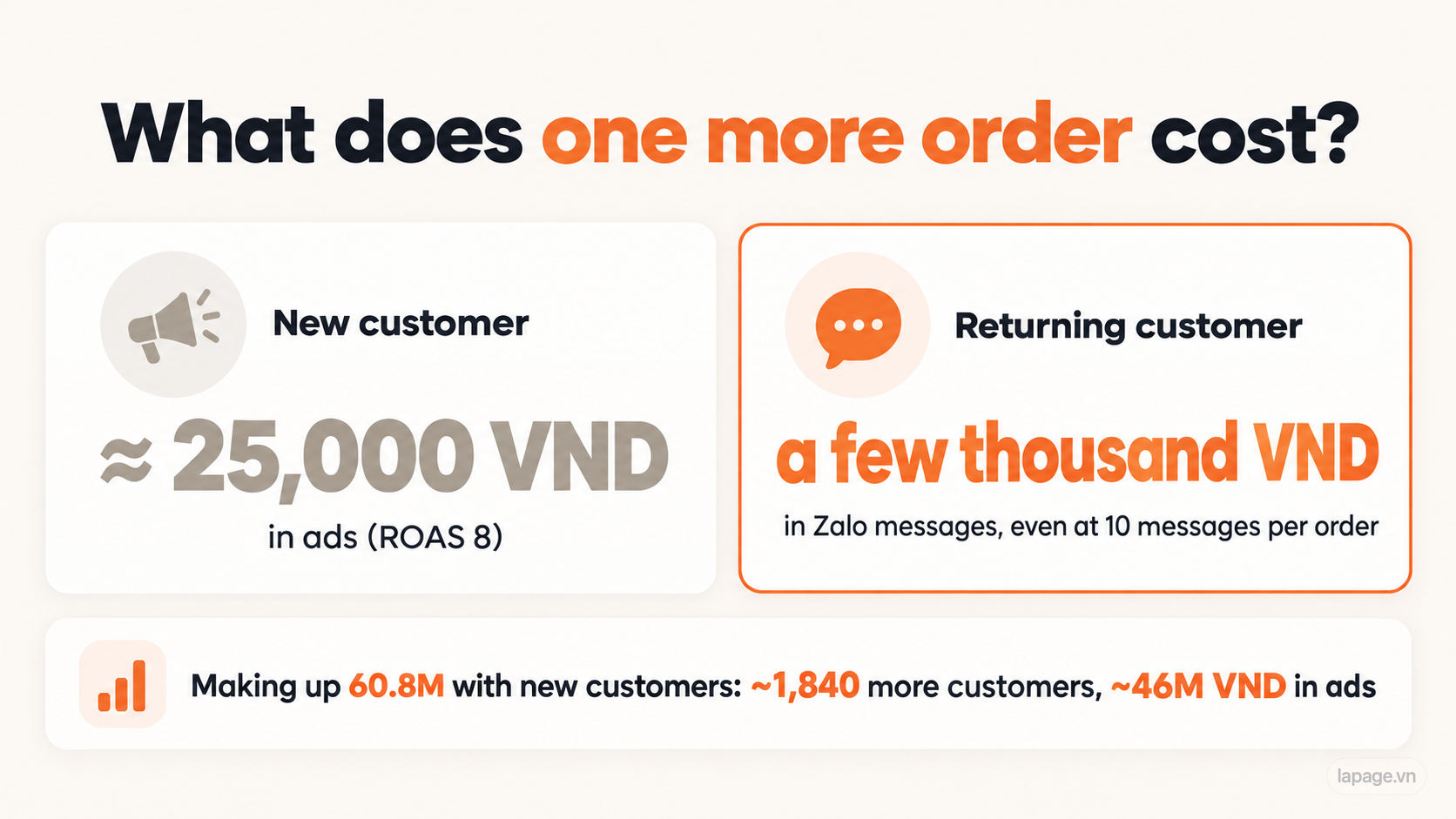
60.8M ÷ 33,000 VND profit per new customer ≈ 1,840 more new customers
1,840 customers × 25,000 VND in ads per order ≈ 46M VND in ads
Reminding a returning customer with a Zalo message costs only a few hundred VND. Even if it takes 10 messages to get one more order, that's still a few thousand VND, compared with 25,000 VND in ads for an order from a new customer.
This isn't only true for online shops. A 2014 Harvard Business Review article summarized that, depending on the industry, acquiring a new customer costs 5 to 25 times more than keeping an existing one; and according to research by Frederick Reichheld (Bain & Company), increasing customer retention by 5% can increase profits by 25% to 95%.
How do you keep customers without breaking marketplace rules?
This is where many shops get it wrong, and get penalized. Based on what Shopee has told the press and its seller FAQ:
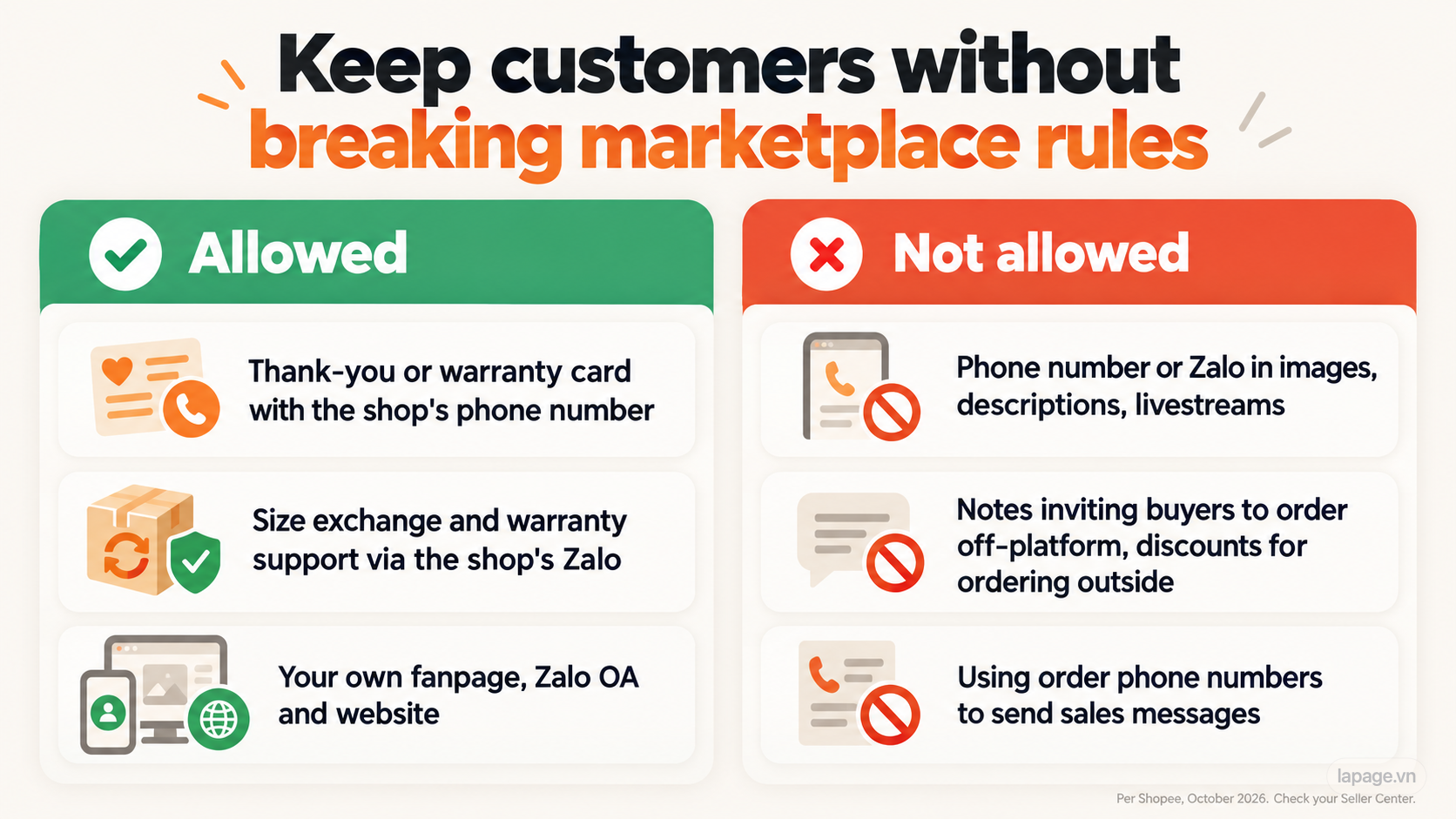
Allowed:
- A thank-you card or warranty card with the shop's phone number, included in the parcel. Shopee states this is not treated as an off-platform transaction.
- Genuine after-sales care: usage guides, size exchanges, warranty through the shop's phone number or Zalo. The customer messages you because they need help, and from then on you can reach them.
- Channels you build yourself: a fanpage, a Zalo Official Account, a website. Customers finding you there is perfectly normal.
Not allowed:
- Putting your phone number, Zalo or website in product images, descriptions, videos, livestreams or marketplace chat.
- Inserting notes that invite customers to buy off-platform, such as "order via Zalo/website for 30% off", or complaining about platform fees to pull customers away. Shopee treats advertising, redirecting or luring buyers off-platform as a violation, even inside the parcel.
- Taking phone numbers from marketplace orders to send sales messages. That breaks platform policy and personal data law.
TikTok Shop has said it doesn't ban inserts that promote other channels, but doesn't encourage them. Marketplace policies change often, so re-read the "off-platform transactions" section in your Seller Center before printing any cards.
On customer data: Vietnam's Law on Personal Data Protection (Law No. 91/2025/QH15) took effect on 1 January 2026. When you store customers' phone numbers to send care messages, tell them clearly what you're storing them for, only message people who have agreed, and delete the number as soon as a customer no longer wants to hear from you. If you're a larger shop or run messaging campaigns at scale, ask a lawyer.
Start this week: 5 concrete steps
- Count how many customers you can actually contact. Not the number of marketplace orders, but the number of customers you could message today. Many shops are surprised how small this number is.
- Print a thank-you card with a warranty slip, showing the shop's hotline/Zalo and a reason to message: "Need a size exchange, care instructions or warranty? Message us." No promotions for buying off-platform.
- Use company accounts, not staff members' personal Zalo. When an employee leaves, your customer list stays with the shop. A Zalo OA, a shop phone number, or one shared customer list.
- Record 3 things for each customer: what they bought, when, and whether they agreed to receive messages. A spreadsheet is enough to start.
- Only message when there's a reason: a product about to run out, a new item that matches what they bought, an offer for regulars. Fewer, well-timed messages beat many.
Calculator: what is your customer list worth?
Enter your shop's numbers. Everything is calculated in your browser; nothing is saved or sent anywhere.
Conclusion
Marketplaces are great for finding new customers. But if every regular has to come back through the marketplace and its ads, you're paying again and again for the same person.
A shop's biggest asset isn't its order count on a marketplace. It's the list of customers you can reach yourself. Nobody can lock that list, and nobody can raise its fees.
What share of your past customers can you contact today?
Sources: VnExpress, "Sellers look for ways to pull customers off Shopee and TikTok Shop", 6 October 2026 (republished by VietnamBiz); Harvard Business Review, "The Value of Keeping the Right Customers", 29 October 2014; Law on Personal Data Protection No. 91/2025/QH15.