AI Agents & Agentic Systems
AI Chatbots Today: 3 Levels, From an AI Driving a Browser to Your Own System
Oct 25, 2026 · 12 min read

11.11 is 15 days away. How to pick hero products, calculate profit before choosing a discount (why a bundle can beat 20% off), prepare videos and hosts, run longer LIVEs with ads that never stop, and keep the customers you win after the sale.


11.11 is 15 days away. For many TikTok shops it's the biggest order day of the quarter. It's also the day it's easiest to "sell a lot and make nothing", or to get orders faster than the warehouse, the packers and the people answering messages can keep up.
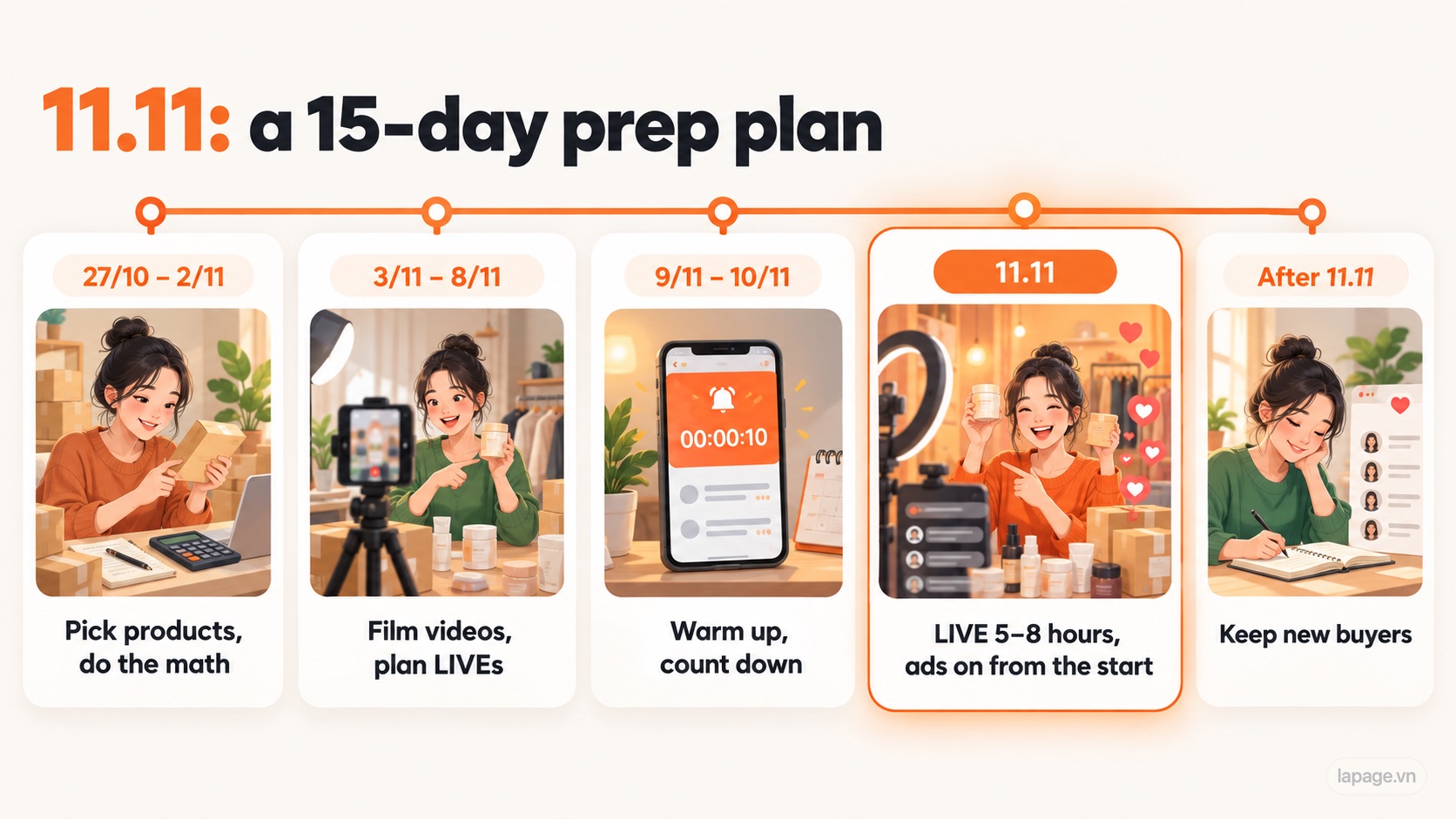
Sale days aren't won by the deepest discount. They're won by whoever prepares earlier. This article splits the remaining 15 days into 5 stages, each with a few concrete tasks. The last stage is the one many shops skip: what to do after 11.11.
The session lengths, time slots and ad practices below are summarized from TikTok's LIVE training materials for sellers, in LaPage's own words. Treat them as guidance, not guaranteed results. For 11.11 campaign eligibility, minimum discounts and any extra fees, check your shop's Seller Center directly.
On sale days people scroll fast. You need one or two products attractive enough to pull viewers into your LIVE and your shop. Usually that's your best seller over the last 30 days, with good reviews and an easy-to-say-yes price.
Don't make slow-moving stock your hero just to clear it. The hero is there to bring people in. Old stock belongs inside bundles, or as a free gift.
This is the step most shops skip. A 20% discount sounds ordinary, but on an order that was already thin, 20% can wipe out the profit.
Take the example from How much do you really make per order after marketplace fees and ads?: an item priced at 200,000 VND, cost 90,000 VND, marketplace fees around 20% + 3,000 VND per order, packaging 5,000 VND, returns around 2% of the price, ads at ROAS 8. On a normal day each order leaves about 33,000 VND.
Keep those assumptions and change only the discount:
| Normal day | 15% off | 20% off | 2-item bundle, 10% off | |
|---|---|---|---|---|
| Price | 200,000 | 170,000 | 160,000 | 360,000 |
| Cost of goods | 90,000 | 90,000 | 90,000 | 180,000 |
| Marketplace fees (20% + 3,000) | 43,000 | 37,000 | 35,000 | 75,000 |
| Packaging + returns | 9,000 | 8,400 | 8,200 | 12,200 |
| Ads (ROAS 8) | 25,000 | 21,250 | 20,000 | 45,000 |
| Left per order | 33,000 | about 13,000 | about 7,000 | about 48,000 |
All amounts in VND.
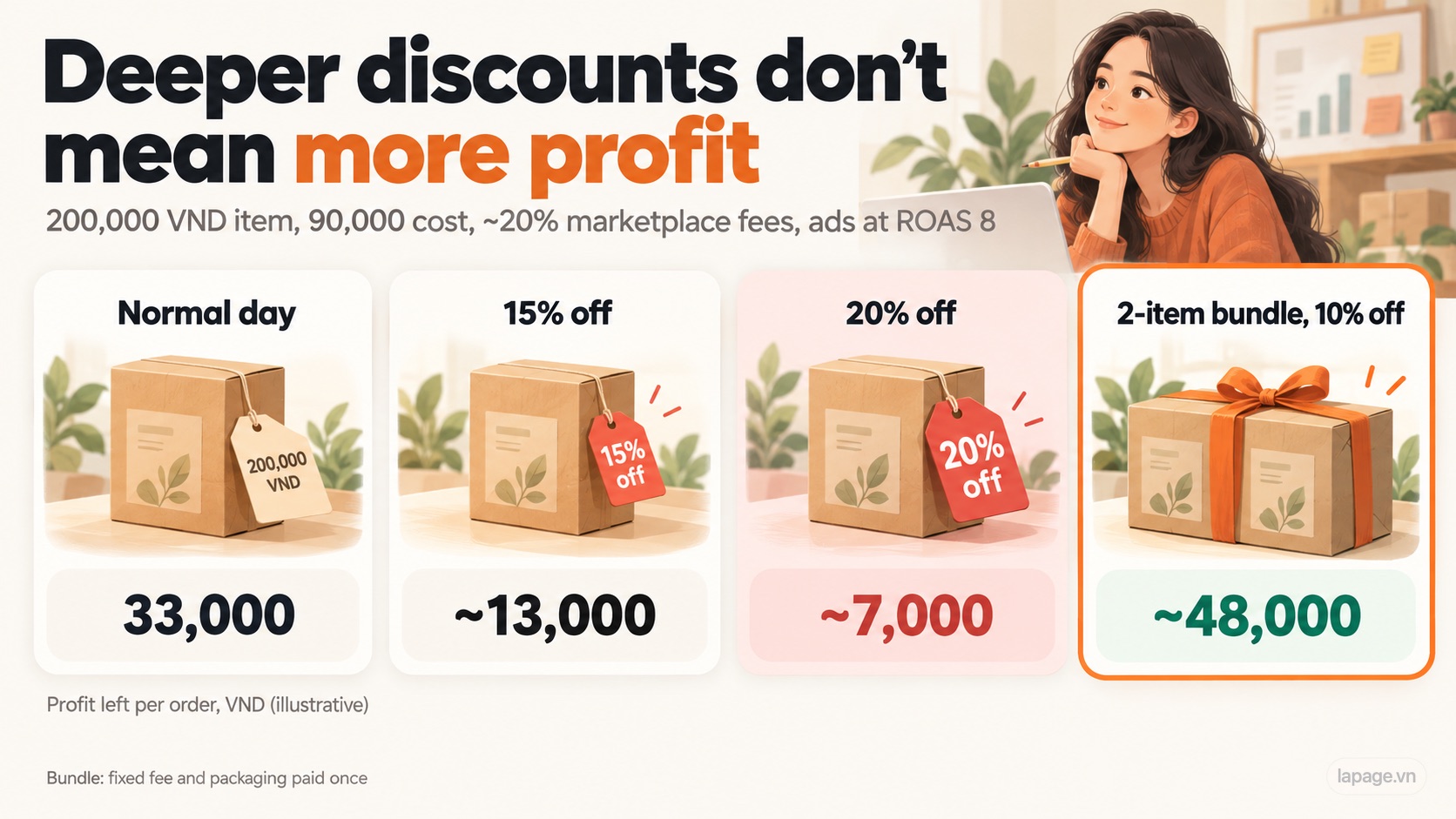
Three takeaways:
Illustrative numbers. Fees vary by category and by the programs your shop joins (some voucher and free-shipping programs add a few percent).
A good bundle solves one need completely: a serum with a mask for acne-prone skin, a top with matching trousers. Not a best seller glued to something nobody wants. One useful approach: use the hero as the "engine" and pair it with a new product to test. A new product that sells well inside bundles can become your next hero.
Plan quantities for 11.11 and the 3–5 days after it. Running out mid-LIVE costs you both the orders and the room's momentum.
On sale days, videos are what bring viewers into the LIVE. Prepare a mix: sale-time announcements, "almost sold out", unboxing, before-and-after, a fun scene with the product. Promotion-specific videos usually get more clicks than ordinary ones, because they give viewers a reason to come in now.
You don't have to shoot everything new. Good moments from past LIVEs can be cut into videos.
Viewers decide in seconds. The room should tell them right away what's on offer:
On a normal day a LIVE should run at least 3 hours. For big sale days, TikTok's training recommends at least 5 hours, and 7–8 hours if you have the people, because revenue per hour tends to jump around hour 5 and again around hour 8. Reference lengths by category: fashion about 6 hours, food and FMCG about 7, lifestyle about 8.
Longer sessions mean host shifts, support shifts, and enough content for every hour.
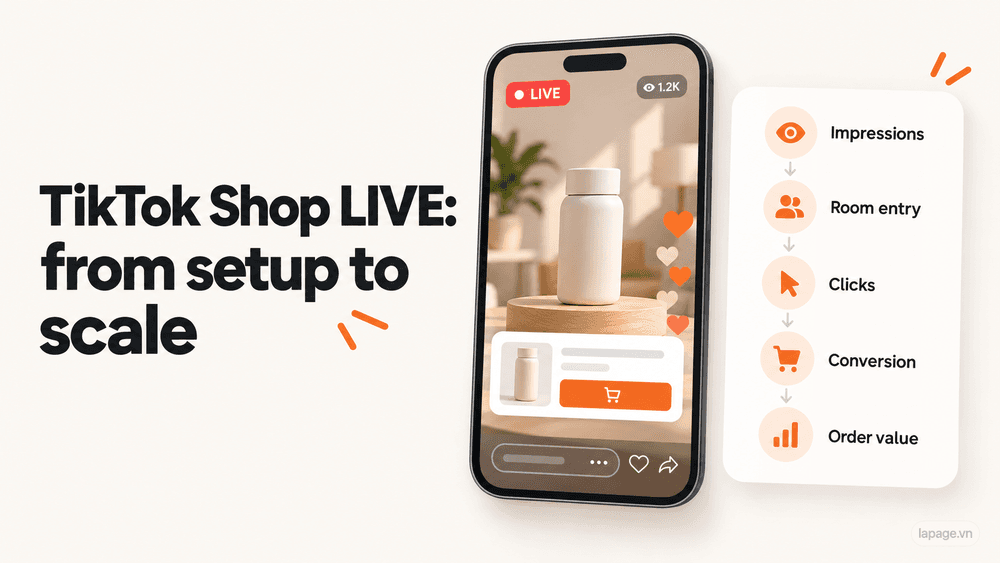
The system looks at the first hour to decide how many more viewers to send. Watch three numbers:
So don't save your best offer for the end. Open with the hero product and a clear deal.
More orders means more work behind them. Prepare:
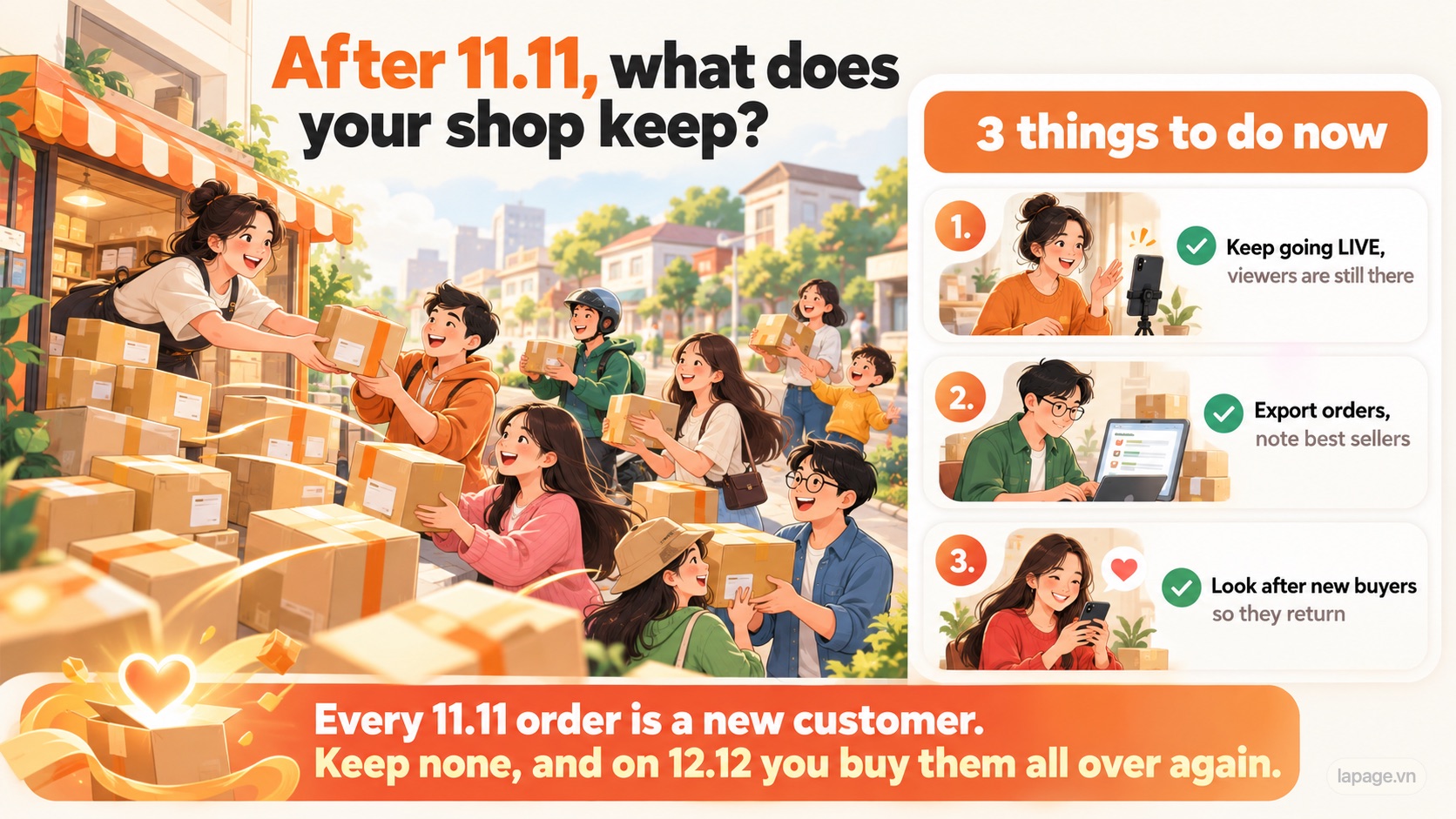
After a sale day, many shops take a few days off. But that's exactly when fewer shops are live while viewers are still around, so it's easier to get attention. Shops that only go live on sale days and then pause for long stretches also tend to see the next sale day perform worse, because the system rewards rooms that are active consistently.
Within a week, while it's fresh, record:
That's your data for a better 12.12. Don't leave it only in the marketplace's reports, which don't show real profit per order.
Every 11.11 order is a new customer. If you keep none of them, on 12.12 you pay for ads to buy customers all over again.
Things you can do now, within the marketplace's rules:
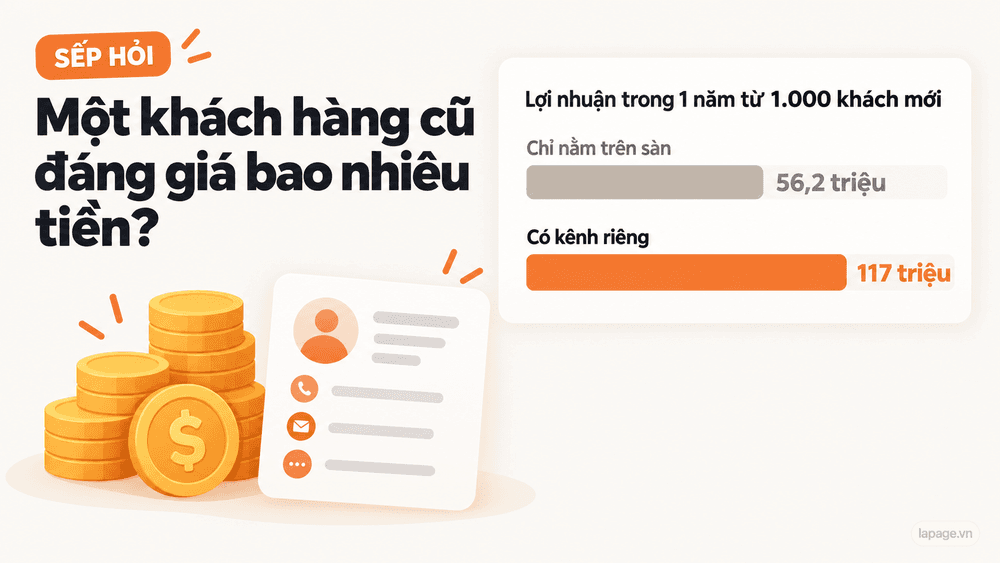
Each marketplace has its own rules about moving customers off-platform, and breaking them can lead to penalties. Read the current policy carefully before printing any contact details in a package. How much is a returning customer worth? runs the numbers: from the same 1,000 new customers, a shop that brings customers back through its own channel can earn about 60 million VND more a year.
27/10 – 2/11
3/11 – 8/11
9/11 – 10/11
On 11.11
After 11.11
Sale-day revenue lives on the marketplace. Your customer list, purchase history and real profit per order should live with you. LaPage helps sellers build their own sales channel and customer management system, so every sale leaves an asset behind, not just a revenue number. Want to talk? Message LaPage.
Which stage is your shop at?
Sources: TikTok for Business LIVE and Commerce training materials for sellers (TikTok Shop LIVE Playbook); profit example from "How much do you really make per order after marketplace fees and ads?" on lapage.vn.
Founder of LaPage Digital, a Vietnam-based digital infrastructure and automation company founded in 2018. Huy Lan is a former Data Engineer at Publicis, where he managed data infrastructure for clients across the APMEA region. He focuses on helping businesses build reliable systems, own their data, and automate operations with practical, maintainable technology.
Subscribe to our newsletter to receive technical insights and updates on best practices for web development and hosting infrastructure.